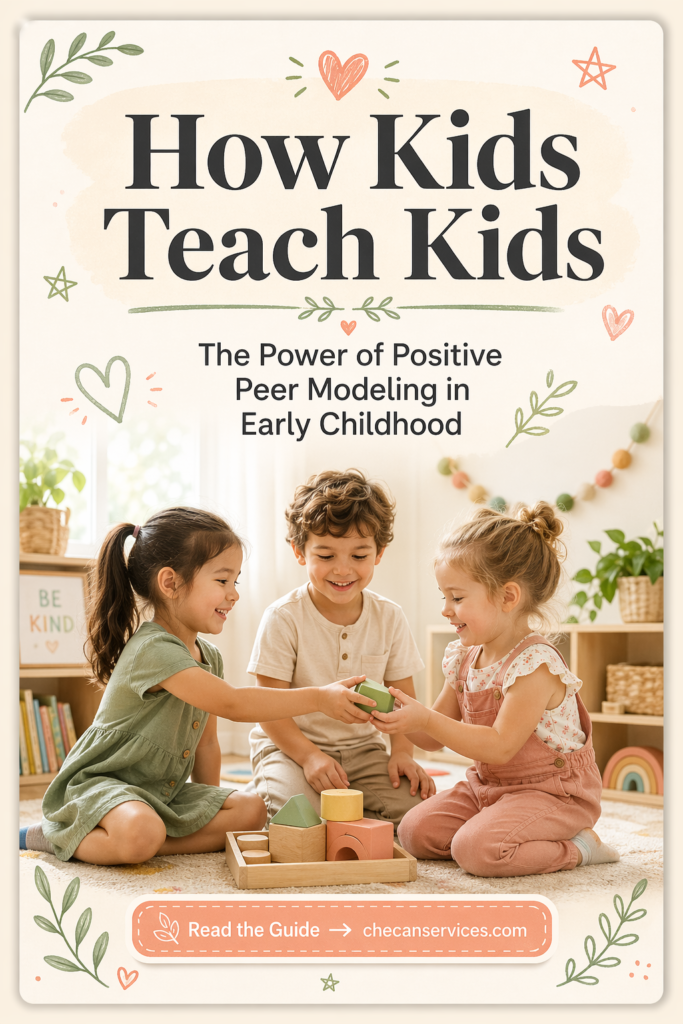
Discover how positive peer modeling helps kids learn empathy, cooperation, and confidence—naturally.
👉 Read more: checanservices.com
Have you ever watched a group of toddlers at a playground and noticed how quickly one child’s laughter spreads to another? Or how a shy preschooler suddenly finds the courage to try the slide after watching a friend go first? That’s peer modeling in action, and it’s one of the most powerful forces shaping your child’s development.
Children are natural imitators. Long before they can fully express themselves with words, they’re watching, absorbing, and copying the behaviors of the little humans around them. Understanding how to harness this natural tendency can transform the way your child learns empathy, builds confidence, and develops social skills that will last a lifetime.
What Is Positive Peer Modeling?
Positive peer modeling happens when children learn desirable behaviors, attitudes, and skills by observing their peers. Unlike lessons from adults, which can sometimes feel like instructions, learning from other children feels natural and relatable. When a child sees a friend sharing a toy, waiting patiently in line, or comforting someone who’s upset, they absorb these behaviors as part of “what kids like me do.”
This kind of learning is especially powerful in early childhood because young children are wired to belong. They want to fit in with their peers, and they’re constantly studying each other for cues on how to behave, speak, and interact with the world.
Why Peer Modeling Matters More Than You Think
The influence of peers in early childhood goes far beyond surface-level behavior. It shapes the foundation of emotional intelligence, cooperation, and leadership. When children are surrounded by positive role models their own age, they develop stronger communication skills, greater empathy, and a deeper sense of community.
If you want to explore this topic more deeply, Bright Influence: How Positive Peer Modeling Shapes Early Childhood offers real-life examples and practical insights that every parent and caregiver will find valuable.
Research shows that children who experience positive peer interactions early in life are more likely to succeed academically, form healthy relationships, and demonstrate resilience during challenging moments. Even the quietest child can blossom into a leader when placed in an environment where kindness and cooperation are the norm.
Everyday Moments That Teach Big Lessons
One of the most beautiful things about peer modeling is that it doesn’t require elaborate setups or structured lessons. The small, everyday moments are where the magic happens. Consider these common scenarios:
During playtime: When one child invites another to join a game, they’re modeling inclusion. The child being invited learns that reaching out is kind, and they’re more likely to do the same for someone else later.
At snack time: A child who thanks the teacher before eating shows others the value of gratitude. Soon, “thank you” becomes second nature for the whole group.
During conflicts: When children witness a peer using words to solve a disagreement instead of hitting or yelling, they learn that communication is a powerful tool.
In quiet moments: Even something as simple as a child sitting calmly and listening can inspire others to slow down and focus.
How to Create an Environment That Encourages Positive Modeling
As a parent, educator, or caregiver, you have more influence than you might realize in shaping the environments where peer modeling thrives. Here are some practical ways to nurture this:
Start by arranging mixed-age playdates or group activities. Younger children often look up to slightly older ones, and older children develop patience and leadership skills when they guide their younger friends.
Celebrate kind behaviors openly. When you notice a child sharing, helping, or comforting another, acknowledge it in a warm, specific way. This not only reinforces the behavior in that child but also signals to others what’s valued.
Choose diverse social settings. Exposing your child to different groups, whether through community classes, neighborhood gatherings, or structured programs, helps them encounter a variety of positive behaviors to learn from.
Most importantly, model positive behavior yourself. Children learn from peers, but they learn from adults too. When your child sees you being patient, kind, and respectful with others, they carry those lessons into their own peer interactions.
Nurturing Quiet Leaders
Not every child is loud or outwardly social, and that’s okay. Some of the most profound leaders emerge from quiet observation. A gentle child who consistently shows kindness can influence an entire group without ever raising their voice. Recognizing and celebrating these quieter forms of leadership helps every child understand that their unique way of contributing matters.
Start Shaping Bright Futures Today
Every small interaction between children is an opportunity for growth, connection, and learning. By understanding the power of positive peer modeling, you can help create environments where children inspire each other to become kind, confident, and compassionate human beings.
To dive deeper into real-life examples and practical strategies, explore Bright Influence: How Positive Peer Modeling Shapes Early Childhood and discover how the small moments in your child’s day can shape a brighter, more compassionate generation.