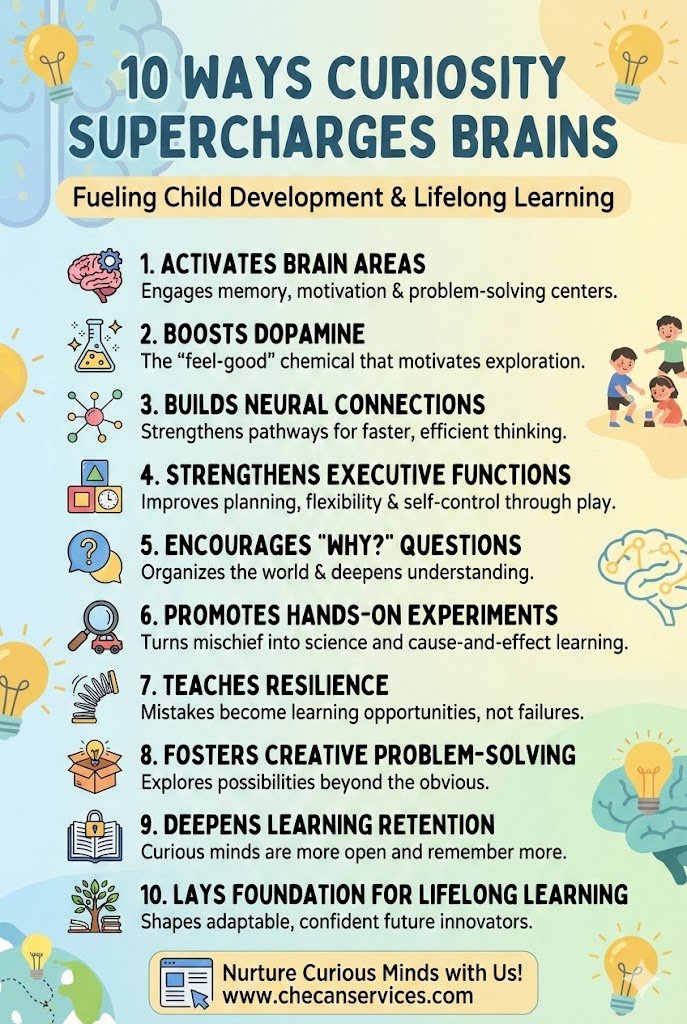
Curiosity is often described as a child’s superpower—and for good reason. From the moment children start reaching, crawling, and asking “why,” their brains are hard at work building connections that shape how they think, learn, and understand the world. Curiosity isn’t just a cute phase; it’s a powerful driver of brain development that lays the foundation for lifelong learning.
When a child wonders why the sky is blue or what happens if they mix paint colors, their brain lights up. Neuroscientists tell us that curiosity activates multiple areas of the brain, especially those linked to memory, motivation, and problem-solving. In simple terms, when children are curious, their brains become more open to learning—and they retain information more deeply.
Curiosity in Action: Everyday Moments That Matter
Think about a child who takes apart a toy just to see what’s inside. While it may look like mischief, it’s actually a hands-on science lesson. That child is experimenting, forming hypotheses, and learning cause and effect. Similarly, when a child asks endless questions during a walk—about ants, leaves, or passing cars—they’re not just stalling bedtime later. They’re actively organizing the world in their mind.
Play is another powerful example. Open-ended play, like building with blocks or pretending to run a shop, encourages children to explore ideas freely. These activities strengthen executive functions such as planning, flexibility, and self-control. Curiosity turns playtime into brain-building time.
The Brain Science Behind “Why?”
Curiosity boosts dopamine, the brain’s “feel-good” chemical associated with motivation and reward. When children discover answers on their own, that dopamine surge reinforces learning, making them more likely to stay engaged and curious in the future. This cycle—question, exploration, discovery—helps neural pathways grow stronger and more efficient.
Even mistakes play a role. When children test an idea that doesn’t work, their brains adapt, learning resilience and creative problem-solving. Curiosity teaches them that learning isn’t about being perfect; it’s about exploring possibilities.
How Adults Can Nurture Curiosity
Supporting curiosity doesn’t require fancy tools or structured lessons. Sometimes, it’s as simple as pausing before giving an answer and asking, “What do you think?” Encouraging children to explore their ideas builds confidence and independence.
Providing diverse experiences also matters. Trips to the park, reading different kinds of stories, cooking together, or observing everyday routines can spark questions and wonder. Most importantly, creating a safe space where curiosity is welcomed—not rushed or dismissed—helps children feel empowered to explore.
Key Takeaways for Growing Curious Minds
Curiosity fuels a child’s brain development by strengthening memory, creativity, and critical thinking. It transforms ordinary moments into meaningful learning experiences and helps children develop a love for discovery that can last a lifetime. When we nurture curiosity, we’re not just answering questions—we’re shaping adaptable, thoughtful, and confident learners.
Looking ahead, the children who are encouraged to stay curious today are the innovators, problem-solvers, and lifelong learners of tomorrow. If you’re passionate about nurturing young minds through thoughtful stories and insights, explore the inspiring ebooks by Louise Blount on Apple Books. You can discover them here and take the next step in supporting curiosity-driven growth—one page at a time.