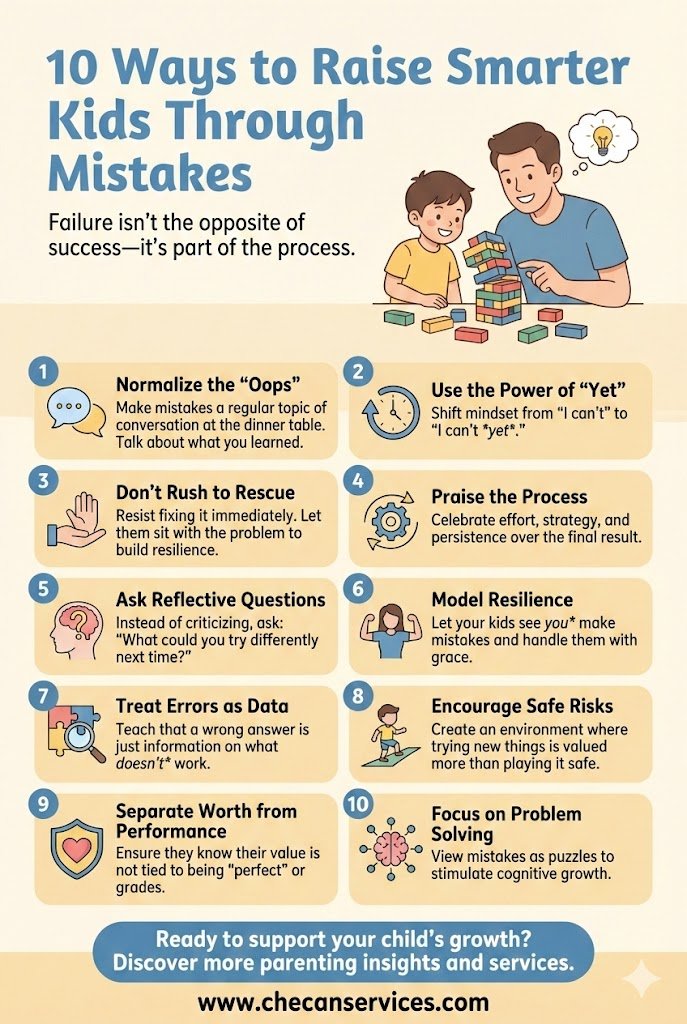
As parents and caregivers, it’s almost instinctive to want to shield children from failure. We jump in to correct homework errors, smooth over social mishaps, and offer quick solutions when things go wrong. But here’s the surprising truth: mistakes are not obstacles to intelligence—they’re the building blocks of it.
Raising smart kids isn’t about creating a perfect, mistake-free childhood. It’s about creating an environment where mistakes are welcomed, explored, and learned from. When children are allowed to stumble, they develop skills that no worksheet or lecture can teach.
How Mistakes Shape Growing Minds
Every mistake a child makes is a moment of cognitive growth. When kids get something wrong, their brains are forced to slow down, reassess, and try again. This process strengthens neural connections and improves problem-solving skills.
Think about a child learning to ride a bike. Falling off isn’t a sign of failure—it’s how balance, coordination, and confidence are built. The same principle applies in the classroom, in friendships, and in creative pursuits. Children who are allowed to fail safely learn how to adapt, rather than freeze when things don’t go as planned.
Mistakes also teach children that intelligence isn’t fixed. When kids realize they can improve through effort, they develop a growth mindset. Instead of thinking, “I’m bad at math,” they begin to think, “I haven’t figured this out yet.” That single shift in thinking can influence how they approach challenges for the rest of their lives.
What Happens When We Don’t Allow Mistakes
When mistakes are constantly corrected or criticized, kids often become risk-averse. They may avoid trying new things out of fear of being wrong. Over time, this can lead to perfectionism, anxiety, and a reluctance to think independently.
For example, a child who is always given the “right” answer may perform well on tests but struggle when faced with real-world problems that don’t have clear solutions. Intelligence in today’s world isn’t just about knowing facts—it’s about creativity, resilience, and adaptability.
Encouraging Healthy Mistake-Making at Home
Supporting learning through mistakes doesn’t mean stepping back entirely. It means responding differently. Instead of asking, “Why did you do that wrong?” try asking, “What do you think happened here?” or “What could you try differently next time?”
Celebrate effort more than outcomes. Praise curiosity, persistence, and willingness to try again. When kids see that mistakes don’t reduce their worth, they become more confident learners and thinkers.
Key Takeaways for Raising Smart, Resilient Kids
Mistakes teach problem-solving, emotional regulation, and perseverance. They help children understand that learning is a process, not a performance. By normalizing mistakes, we prepare kids for a future that values innovation, adaptability, and lifelong learning.
Looking ahead, the smartest kids won’t be the ones who never failed—they’ll be the ones who learned how to fail well, recover quickly, and keep going.
If you’re interested in deeper insights on parenting, growth, and personal development, explore the inspiring ebooks by Louise Blount on Apple Books. You can browse her collection here and discover thoughtful reads that support mindful, confident parenting—perfect for guiding both you and your children forward.