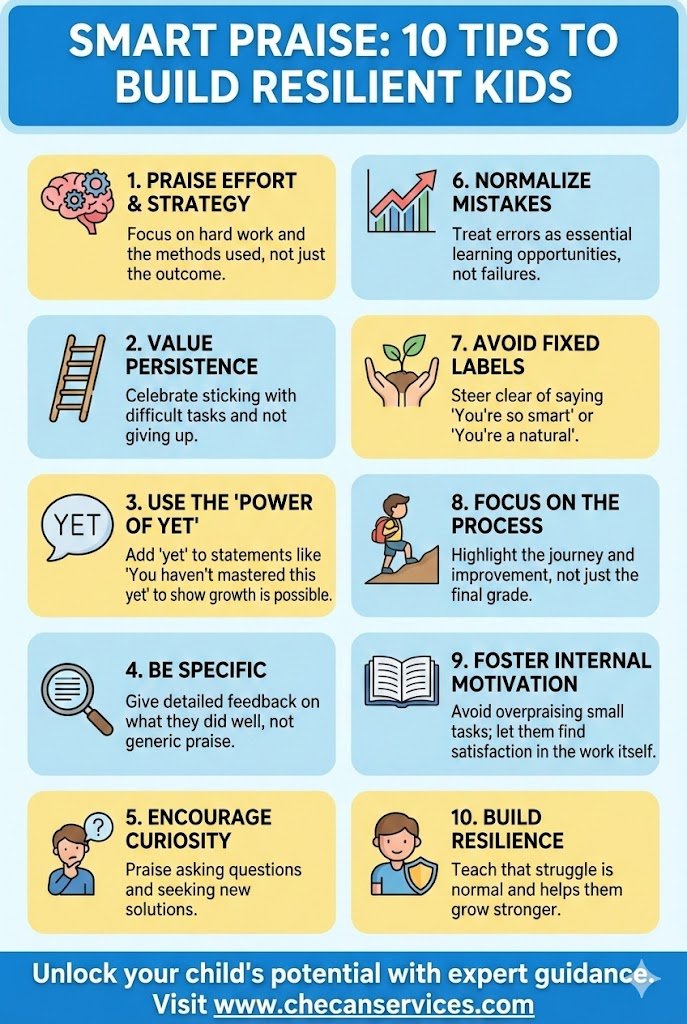
Most parents and teachers agree on one thing: praise feels like the right thing to do. A quick “You’re so smart!” or “Great job!” seems harmless, even motivating. But decades of research suggest that how we praise children can shape not only how well they learn—but how confident they feel when learning gets hard.
Let’s unpack why praise can be a powerful tool for building intelligence or a quiet confidence killer.
When Praise Helps Kids Grow
Praise works best when it focuses on effort, strategies, and persistence, not fixed traits. This idea comes largely from the work of Carol Dweck, whose research on mindset shows that children thrive when they believe abilities can be developed.
For example, imagine two kids solving a math problem.
- Child A hears: “You’re so smart!”
- Child B hears: “I like how you tried different ways to solve that.”
At first, both feel good. But when the problems get harder, Child A is more likely to freeze up. If they struggle, it threatens their “smart” label. Child B, on the other hand, sees struggle as part of the process. Effort-based praise teaches kids that progress comes from practice, not perfection.
Over time, this kind of feedback builds resilience. Kids become more willing to take risks, ask questions, and stick with challenges—key ingredients for real learning.
When Praise Backfires
Ironically, praise meant to boost confidence can sometimes do the opposite.
Trait-based praise like “You’re a natural” or “You’re gifted” can create pressure. Kids may start avoiding difficult tasks because failure feels like proof that the praise wasn’t true. Instead of thinking, “I didn’t learn this yet,” they think, “Maybe I’m not actually smart.”
There’s also the issue of overpraise. Constant, inflated praise for small efforts can make kids dependent on external validation. Rather than developing internal motivation, they begin to look for approval before taking initiative.
In short, praise that focuses on outcomes instead of process can quietly undermine confidence—especially when mistakes enter the picture.
Real-World Examples That Matter
In classrooms, teachers who shift from “Excellent work!” to “Your revision made this argument clearer” often see students engage more deeply. At home, parents who say, “That was tough, but you stuck with it,” help normalize struggle as part of growth.
Even something as small as adding the word “yet”—“You haven’t mastered this yet”—can change how kids interpret difficulty.
These small language choices send a big message: learning is dynamic, and setbacks are temporary.
Key Takeaways for Smarter, More Confident Kids
- Praise effort, strategies, and improvement, not intelligence or talent
- Normalize mistakes as part of learning
- Be specific—kids learn more from detailed feedback than generic praise
- Encourage curiosity and persistence over perfect results
Looking Ahead
As education and parenting continue to evolve, one thing is clear: words matter. Thoughtful praise doesn’t just make kids feel good in the moment—it shapes how they see themselves as learners for years to come.
If you enjoy reflective, research-informed insights on growth, confidence, and personal development, you may want to explore the ebooks by Louise Blount available on Apple Books. You can browse them all here on Apple Books and discover thoughtful reads that gently support lifelong learning—for kids and adults alike.