Play might look simple—blocks on the floor, a pretend tea party, a toddler chasing bubbles—but beneath the giggles is serious brain work happening. For toddlers, play isn’t a break from learning; it is learning. Through playful moments, children build intelligence in ways that are deep, lasting, and surprisingly sophisticated.
Why Play Is a Toddler’s First Classroom
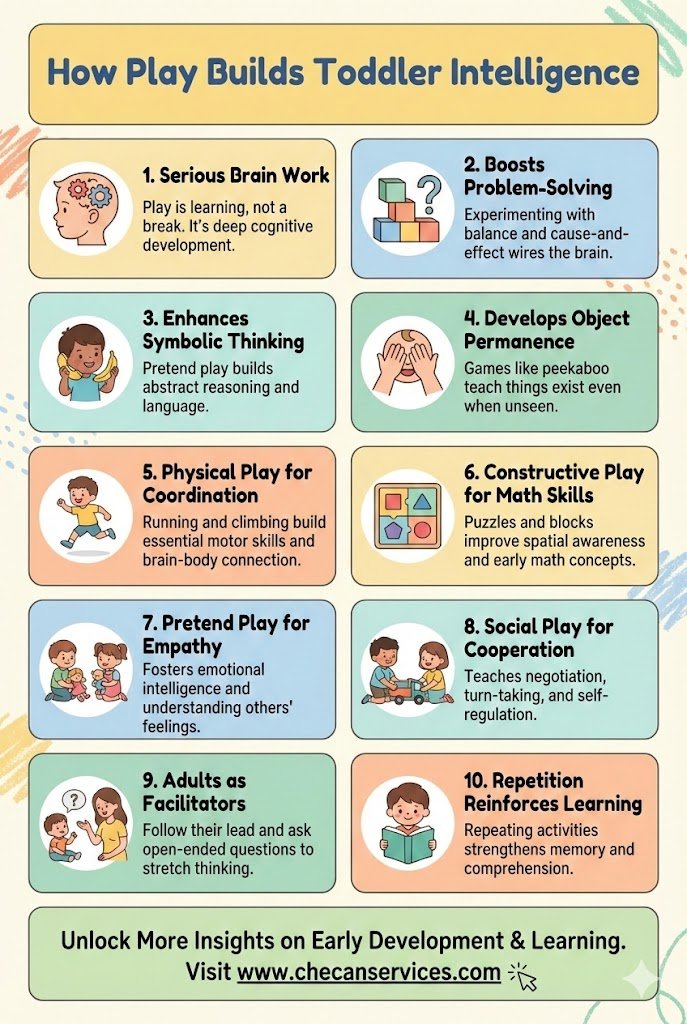
Toddlers learn best when they’re curious and engaged. Play naturally creates that environment. When a child stacks blocks, they’re experimenting with balance, gravity, and cause-and-effect. When they pretend a spoon is an airplane, they’re practicing symbolic thinking—an early foundation for language and abstract reasoning.
Even simple games like peekaboo help toddlers understand object permanence (the idea that things still exist even when out of sight). These playful discoveries wire the brain for problem-solving and flexible thinking later on.
Different Types of Play, Different Kinds of Intelligence
Not all play is the same, and that’s a good thing. Each type of play strengthens different cognitive skills:
- Physical play (running, climbing, dancing) boosts motor skills and supports brain-body coordination.
- Constructive play (blocks, puzzles, shape sorters) builds spatial awareness and early math thinking.
- Pretend play enhances language development, emotional intelligence, and creativity.
- Social play teaches cooperation, empathy, and problem-solving with others.
For example, when two toddlers argue over a toy and then figure out how to take turns, they’re practicing negotiation and self-regulation—skills closely tied to executive function.
The Role of Adults in Play-Based Learning
Adults don’t need to lead play to make it educational. In fact, toddlers often learn more when adults follow their lead. Asking open-ended questions like, “What happens if we try this?” or “Can you show me another way?” gently stretches a child’s thinking without taking over.
It’s also okay for play to be messy, slow, or repetitive. A toddler who wants to read the same book ten times isn’t stuck—they’re reinforcing memory, language patterns, and comprehension.
Play Today, Thinkers Tomorrow
Research consistently shows that play-rich early childhood experiences are linked to stronger problem-solving skills, better emotional regulation, and higher academic confidence later on. Play helps toddlers learn how to think, not just what to think.
In a world that’s increasingly fast-paced and tech-driven, unstructured, imaginative play becomes even more valuable. It nurtures curiosity—the very trait that fuels lifelong learning.
Key Takeaways
Play is a powerful engine for toddler intelligence. It builds cognitive, emotional, and social skills simultaneously, all while feeling joyful and natural. By protecting time and space for play, parents and caregivers are investing in a child’s future thinking, creativity, and resilience.
If you enjoy thoughtful insights on early childhood development, storytelling, and nurturing young minds, you may love exploring the ebooks by Louise Blount available on Apple Books. They’re a wonderful resource for parents who want to support learning in meaningful, everyday ways.