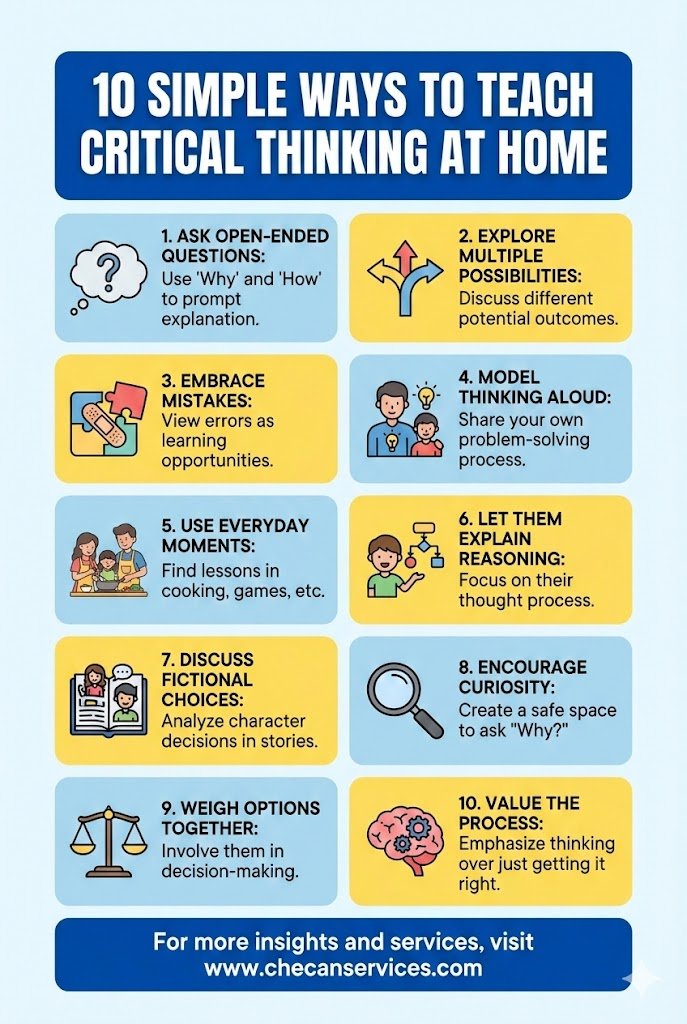
Teaching critical thinking at home doesn’t require special worksheets, expensive programs, or a background in education. In fact, some of the most powerful lessons happen during everyday moments—while cooking dinner, watching a movie, or solving small problems together. Critical thinking is really about helping children learn how to think, not what to think, and that’s something families are uniquely positioned to nurture.
At its core, critical thinking encourages curiosity, reflection, and confidence in decision-making. When children learn to ask questions, weigh options, and explain their reasoning, they develop skills that support learning far beyond academics.
Ask Open-Ended Questions Every Day
One of the simplest ways to build critical thinking is by changing how we ask questions. Instead of “What color is this?” try “Why do you think this works that way?” or “What might happen if we tried something different?” Open-ended questions invite children to explain their thoughts and consider multiple possibilities.
For example, after reading a story together, ask, “Why do you think the character made that choice?” or “What would you have done differently?” These conversations encourage reasoning without pressure to be “right.”
Turn Mistakes into Learning Moments
At home, mistakes can be powerful teachers. When a child struggles with a puzzle or gets an answer wrong, resist the urge to jump in immediately. Ask guiding questions like, “What part feels tricky?” or “What could you try next?” This helps children analyze problems and build resilience.
Even adults can model this. Saying, “I tried this and it didn’t work—let me think it through again,” shows that thinking critically is an ongoing process, not a one-time success.
Encourage Curiosity Through Everyday Activities
Critical thinking thrives when children feel safe asking “why.” Cooking is a great example: measuring ingredients, adjusting recipes, and predicting outcomes all involve analysis and decision-making. Games, building projects, and even planning a family outing can become opportunities to evaluate choices and consider consequences.
Watching a show together? Pause and ask, “Do you think that was a good decision?” or “What clues tell us what might happen next?” These small habits add up.
Let Children Explain Their Thinking
When children explain how they arrived at an answer, they strengthen both logic and communication skills. Instead of focusing only on outcomes, ask them to walk you through their process. This reinforces that thinking matters just as much as results.
Over time, children become more confident expressing ideas and evaluating information independently—an essential skill in a world full of opinions and information.
Key Takeaways for Building Critical Thinkers at Home
Teaching critical thinking doesn’t require formal lessons. It grows through conversation, patience, and intentional moments woven into daily life. By asking thoughtful questions, embracing mistakes, and encouraging curiosity, you’re helping children develop skills that will serve them well in school, relationships, and future careers.
If you’re looking for thoughtful, engaging resources that support deeper thinking and reflection, you may enjoy exploring the ebooks by Louise Blount available on Apple Books. Discover stories and ideas designed to inspire learning and personal growth by visiting Apple Books.