If you’ve ever watched a child freeze when faced with a tricky math question, a long homework assignment, or even a social challenge, you know how overwhelming complex problems can feel to young minds. The good news? Problem-solving isn’t a talent children either have or don’t have. It’s a skill—and one that can be taught, practiced, and strengthened over time.
Breaking down complex problems into manageable pieces helps children build confidence, independence, and resilience. More importantly, it prepares them for a world where clear answers aren’t always obvious.
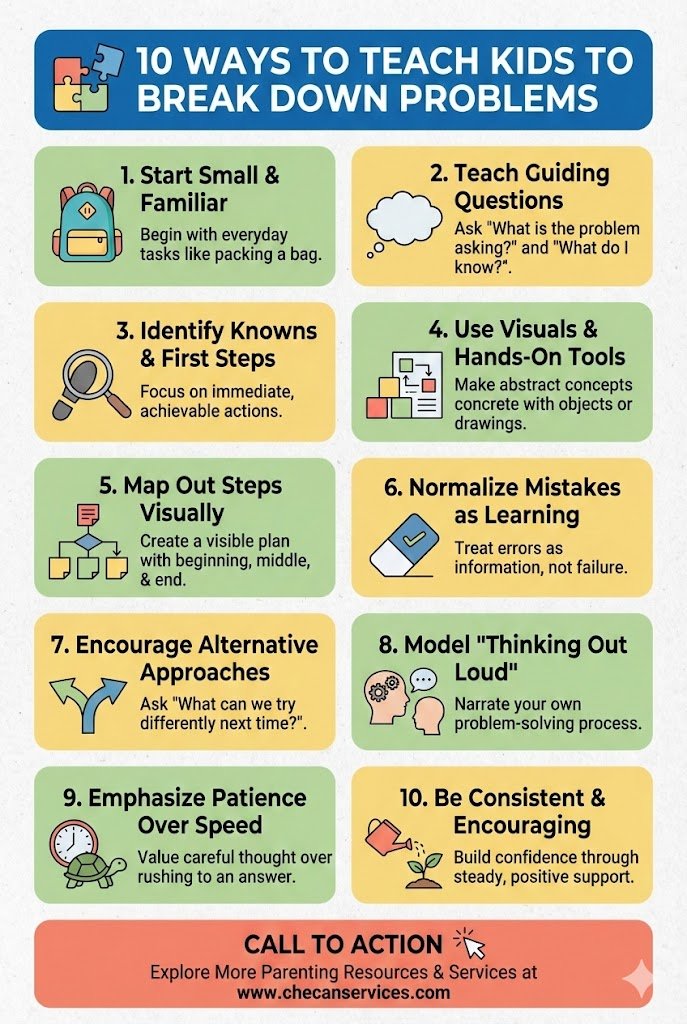
Start With Smaller, Familiar Problems
Children learn best when new skills connect to what they already understand. Before tackling big challenges, give them experience with smaller, everyday problems. For example, if a child struggles with organizing a school project, start with something simple like planning their backpack for the next day.
You might say, “Let’s list what needs to go into your bag,” and work through it step by step. This teaches them that even confusing tasks have a beginning, middle, and end.
Teach the Power of Asking the Right Questions
One of the most effective ways to help children break down problems is by modeling curiosity. Encourage them to ask questions such as:
- What is the problem really asking?
- What do I already know?
- What’s one small step I can take first?
For instance, when reading a complex word problem, help them underline key information and circle what needs to be solved. Over time, they’ll start doing this naturally, without being prompted.
Make It Visual and Hands-On
Children often understand concepts better when they can see or touch them. Drawing diagrams, using blocks, or writing steps on sticky notes can make abstract problems feel more concrete.
Imagine a child trying to understand fractions. Instead of relying only on numbers, use slices of fruit or pieces of paper. Showing how a whole breaks into parts reinforces the idea that complex problems are simply collections of smaller ones.
Normalize Mistakes and Revisions
Many children shut down because they’re afraid of getting the “wrong” answer. Teach them that mistakes are part of the process. When something doesn’t work, treat it as information rather than failure.
You can say, “Okay, that step didn’t work—what can we try differently?” This mindset encourages flexibility and persistence, two essential problem-solving skills they’ll carry into adulthood.
Practice Thinking Out Loud
Thinking out loud helps children hear how problems can be broken into steps. Walk them through your own reasoning when you face challenges, whether it’s budgeting groceries or planning a trip.
This shows them that even adults don’t solve everything instantly—and that careful thinking beats rushing every time.
Key Takeaways for Parents and Educators
Teaching children to break down complex problems is about consistency, patience, and encouragement. Start small, ask guiding questions, use visuals, and create a safe space for trial and error. Over time, these habits become second nature, empowering children to approach challenges with confidence rather than fear.
Looking ahead, children who master this skill won’t just do better in school—they’ll be better prepared for real-life decisions, creative thinking, and lifelong learning.
If you’re interested in nurturing thoughtful, resilient young minds through engaging stories and practical insights, explore the ebooks by Louise Blount on Apple Books. You can discover them here. They’re a wonderful resource for parents and educators looking to support children’s growth in meaningful ways.