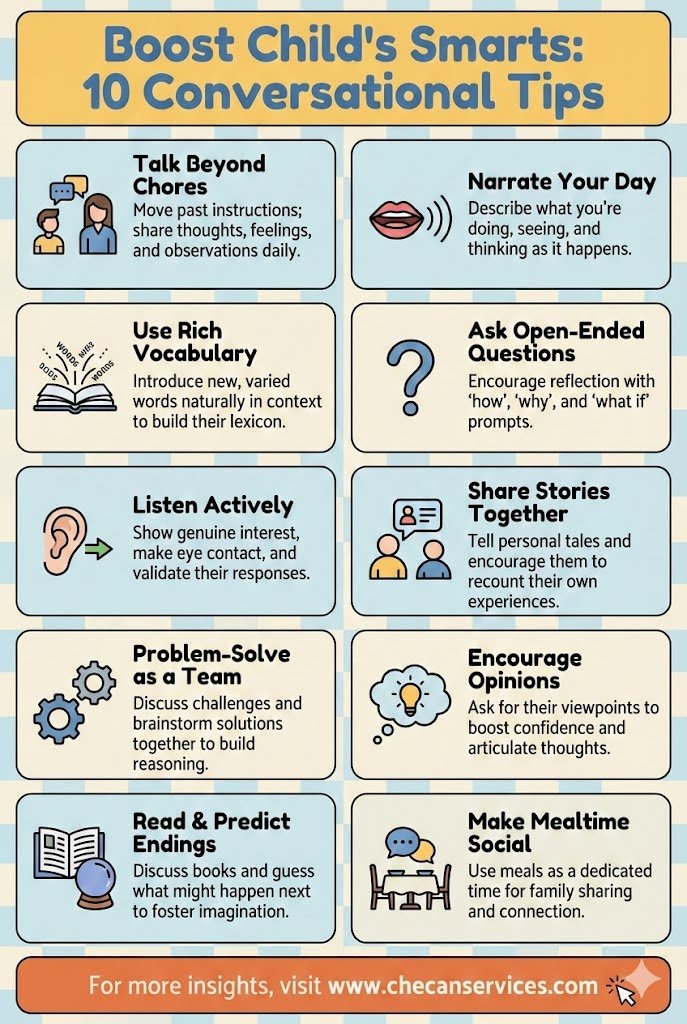
How often do you really talk with your child—beyond reminders, instructions, or quick check-ins? Those everyday family conversations, whether at the dinner table or during a car ride, are doing far more than filling silence. They’re quietly shaping your child’s language skills, thinking ability, and long-term intelligence.
From a young age, children learn through interaction. When families engage in open, meaningful conversations, children are exposed to vocabulary, sentence structure, emotional cues, and problem-solving patterns that no screen or worksheet can fully replace. The beauty is that this learning happens naturally, without pressure, and often without parents realizing how powerful these moments truly are.
Why Talking at Home Matters More Than You Think
Language grows through use. When children hear diverse words and ideas in daily conversation, their brains begin making connections—linking sounds to meanings, and meanings to concepts. For example, a simple question like, “Why do you think the sky changed color tonight?” encourages a child to reflect, reason, and respond using their own words.
These exchanges build what educators often call “cognitive flexibility.” Children learn to explain their thoughts, listen to others, and adapt their responses. Over time, this strengthens memory, comprehension, and even emotional intelligence. It’s not about using complex words—it’s about creating space for curiosity and dialogue.
Everyday Moments That Spark Intelligence
Family conversations don’t need to be formal or educational to be effective. Some of the most impactful exchanges happen during routine moments:
- Meal times, where everyone shares something about their day
- Storytelling before bed, especially when children are encouraged to predict or imagine alternative endings
- Problem-solving together, like discussing how to fix something or plan a weekend activity
These moments teach children how to organize their thoughts and express them clearly. They also show that their opinions matter—boosting confidence alongside intelligence.
The Long-Term Impact on Learning and Success
Children who grow up in conversation-rich environments often develop stronger reading and writing skills later on. They tend to ask more questions, engage more deeply in school, and approach challenges with curiosity rather than fear. Conversation teaches them how to think, not just what to think.
Importantly, these benefits compound over time. A child who learns to articulate ideas at home is better prepared for classrooms, friendships, and eventually professional settings. Language becomes a tool for connection, creativity, and leadership.
Key Takeaways for Parents and Caregivers
You don’t need special training to support your child’s intellectual growth—just intention. Talk often, listen actively, and invite your child into real conversations. Ask open-ended questions. Share stories. Wonder out loud. These simple habits create a foundation that supports lifelong learning.
As you nurture these conversations, you may also enjoy exploring stories that celebrate communication, growth, and imagination. Discover engaging ebooks that inspire thoughtful dialogue and meaningful moments by visiting Louise Blount’s ebooks on Apple Books—a gentle way to bring more language-rich experiences into your family’s everyday life.