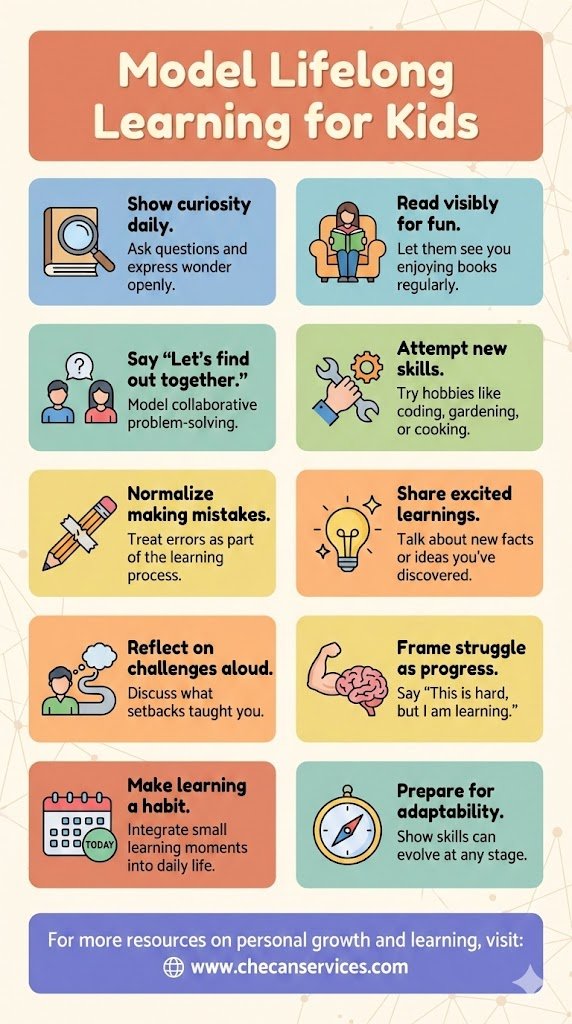
Children are always watching. Long before they understand lectures about responsibility or ambition, they’re quietly absorbing how adults approach growth, curiosity, and change. That’s why modeling lifelong learning matters so much for children—not as a theory, but as a lived, everyday practice.
When kids see adults reading for pleasure, asking questions, trying new skills, or even struggling through something unfamiliar, they learn a powerful lesson: learning doesn’t stop at school. It’s a lifelong companion.
Learning Is Caught, Not Just Taught
Think about the moments that shape children the most. It’s not usually a formal lesson. It’s watching a parent look up an unfamiliar word, take an online course, experiment with a new recipe, or talk excitedly about something they’ve just discovered.
When adults model learning:
- Children associate curiosity with normal, adult life
- Mistakes become part of the process, not something to fear
- Growth feels ongoing instead of age-limited
A parent who says, “I don’t know, let’s find out together,” teaches far more than one who always provides the answer.
Building a Growth-Oriented Mindset Early
Children who grow up seeing learning as continuous are more likely to:
- Embrace challenges instead of avoiding them
- Recover faster from setbacks
- Stay curious as teens and adults
Modeling learning shows children that intelligence isn’t fixed. Skills can be developed, perspectives can evolve, and reinvention is allowed at any stage of life. This mindset becomes especially valuable in a world where careers, technology, and social expectations are constantly changing.
Everyday Examples That Make a Difference
You don’t need formal credentials or structured lessons to model lifelong learning. Small, consistent behaviors make a big impact:
- Reading books, articles, or audiobooks regularly
- Talking openly about what you’re learning or unlearning
- Exploring hobbies like photography, coding, writing, or gardening
- Reflecting out loud on mistakes and what they taught you
Even saying, “This is hard, but I’m learning,” reframes difficulty as progress in motion.
Preparing Children for an Uncertain Future
The future children are growing into will demand adaptability more than memorization. Jobs will change. Skills will evolve. The ability to learn, relearn, and stay curious will be one of their greatest advantages.
By modeling lifelong learning, adults give children an internal compass. Instead of asking, “Am I good enough?” they learn to ask, “What can I learn next?”
Key Takeaways
- Children mirror adult attitudes toward learning
- Curiosity modeled at home strengthens confidence and resilience
- Learning doesn’t require perfection—just participation
- Lifelong learning prepares children for flexibility and growth
Looking Ahead
When adults treat learning as a natural, ongoing part of life, children inherit permission to grow without limits. That example stays with them far longer than any single lesson.
If you’re looking for thoughtful, reflective reads that support personal growth, curiosity, and lifelong learning, explore the inspiring ebooks by Louise Blount available on Apple Books. Discover them here and let your own learning journey continue—because children learn best from what we live, not just what we say.