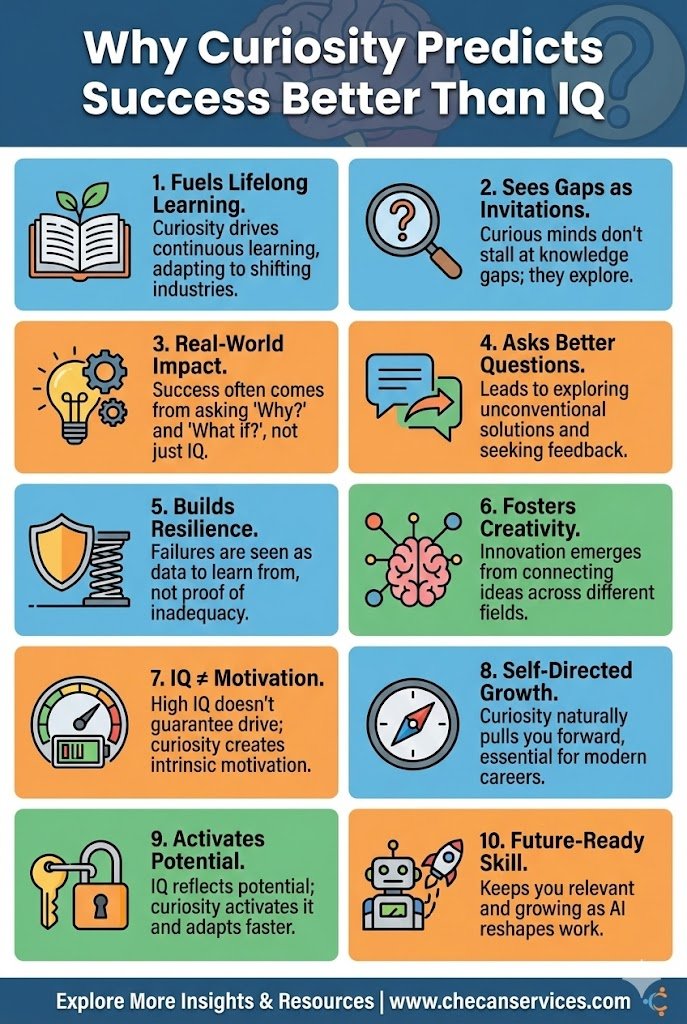
For decades, IQ has been treated like a crystal ball for success. High score? Bright future. Average score? Limited potential. But real life keeps poking holes in that theory. Some of the most successful entrepreneurs, creators, and leaders weren’t necessarily the “smartest” in the room—they were the most curious. And curiosity, it turns out, may be the better long-term predictor of success.
Curiosity Fuels Lifelong Learning
IQ measures what you can do with what you already know. Curiosity measures how motivated you are to keep learning. In a world where industries shift, tools evolve, and job roles didn’t even exist ten years ago, the ability to continuously learn matters more than static intelligence.
Think of someone who constantly asks, “Why does this work?” or “What happens if I try a different approach?” That mindset leads to new skills, broader perspectives, and adaptability. A curious person doesn’t stall when they hit a gap in knowledge—they see it as an invitation.
Real-World Success Stories Back This Up
Take entrepreneurs like Richard Branson, who has openly spoken about struggling academically. What set him apart wasn’t test performance but a relentless curiosity about people, problems, and possibilities. Or consider engineers who pivot into product leadership—not because they had the highest IQs, but because they were curious about users, markets, and systems beyond their original scope.
In everyday work environments, curiosity shows up as asking better questions in meetings, exploring unconventional solutions, and seeking feedback instead of avoiding it. These behaviors compound over time and often lead to leadership opportunities.
Curiosity Builds Resilience and Creativity
Highly curious people tend to see failures differently. Instead of viewing mistakes as proof of inadequacy, they treat them as data. What can I learn from this? That question alone builds resilience.
Creativity also thrives on curiosity. New ideas rarely appear out of nowhere; they emerge when someone connects dots across disciplines, experiences, or interests. Curious minds wander—and that wandering often leads to innovation.
IQ Doesn’t Guarantee Motivation
Here’s the quiet limitation of IQ: it says nothing about drive. You can be intellectually capable and still disengaged. Curiosity, on the other hand, naturally pulls you forward. It creates intrinsic motivation—the kind that doesn’t need constant rewards or external pressure.
In modern careers, where self-direction is increasingly expected, motivation may matter more than raw cognitive ability.
Key Takeaways
- IQ reflects potential; curiosity activates it
- Curious people adapt faster in changing environments
- Asking better questions often beats having quick answers
- Curiosity strengthens creativity, resilience, and leadership
Looking Ahead
As automation and AI reshape work, the most valuable humans won’t just be those who know the most—but those who are eager to explore what’s next. Curiosity keeps you relevant, engaged, and growing long after formal education ends.
If you’re interested in developing a mindset rooted in curiosity, growth, and self-discovery, you may enjoy exploring the ebooks available by Louise Blount on Apple Books. You can find them here, a thoughtful collection designed to gently inspire reflection and personal progress.