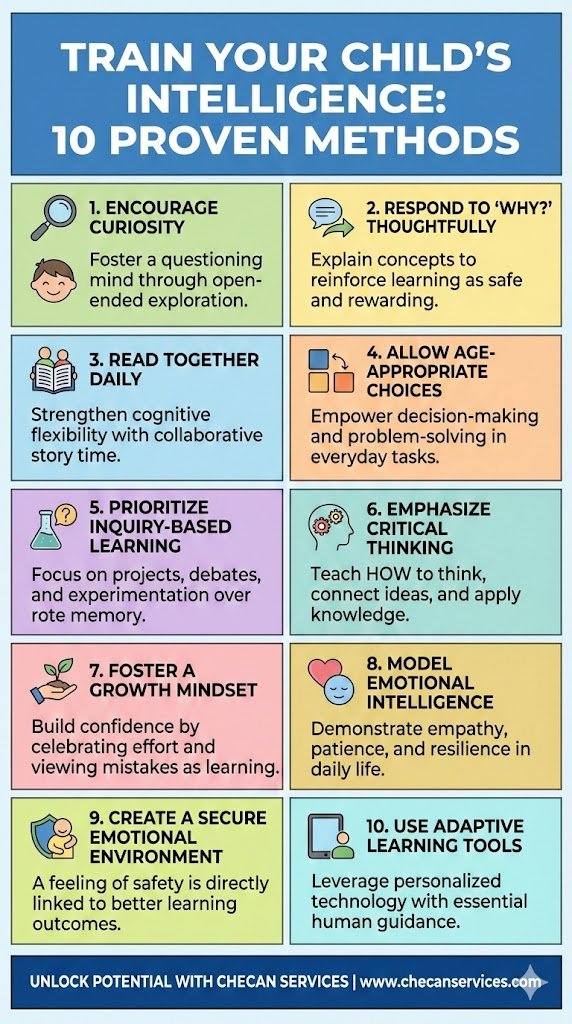
This easy-to-read parenting infographic shares research-backed ways to boost curiosity, critical thinking, emotional intelligence, confidence, and lifelong learning—perfect for parents and educators looking for practical guidance.
It’s a question many parents, teachers, and caregivers quietly wrestle with: Is intelligence something a child is born with, or something that can be shaped over time? Modern research and real-world experience increasingly point to a hopeful answer—intelligence isn’t fixed. It’s flexible, responsive, and deeply influenced by parenting and education.
For decades, intelligence was viewed as a static trait measured by IQ tests. Today, that thinking feels outdated. We now understand intelligence as a collection of skills—critical thinking, emotional regulation, creativity, adaptability—that grow through experience. And the earliest experiences matter more than we once imagined.
Parenting plays a foundational role in this process. Children raised in environments that encourage curiosity tend to ask more questions, explore more freely, and develop stronger problem-solving skills. Something as simple as a parent responding thoughtfully to a child’s “why” can reinforce the idea that learning is safe and rewarding. Reading together, discussing everyday decisions, and allowing children to make age-appropriate choices all help strengthen cognitive flexibility.
Education builds on that foundation, but not just through textbooks and tests. The most effective learning environments emphasize how to think, not just what to memorize. When schools prioritize inquiry-based learning—projects, debates, experimentation—students learn to connect ideas and apply knowledge in real-world contexts. These are the skills that matter in a rapidly changing world.
Consider two classrooms teaching the same subject. One focuses on rote memorization; the other encourages students to explore problems collaboratively, make mistakes, and reflect. Over time, the second group often develops stronger reasoning skills and confidence. That confidence is key. When children believe their abilities can grow, they’re more willing to tackle challenges rather than avoid them.
Another powerful factor is emotional intelligence. Parenting styles that model empathy, patience, and resilience help children manage stress and regulate emotions—skills directly linked to better learning outcomes. A child who feels emotionally secure is more open to learning, more persistent, and better equipped to handle setbacks.
Technology and modern education are also reshaping how intelligence is trained. Adaptive learning tools, personalized curriculums, and interactive content allow children to learn at their own pace. But even with these advances, the human element remains essential. Guidance, encouragement, and meaningful relationships amplify the impact of any educational tool.
Key Takeaways
- Intelligence is not fixed; it develops through interaction, experience, and guidance
- Parenting that encourages curiosity and emotional safety supports cognitive growth
- Education that emphasizes critical thinking over memorization builds adaptable intelligence
- Emotional intelligence is just as important as academic skills
Looking Ahead
As our understanding of the brain continues to evolve, the future of intelligence training looks increasingly holistic. The most effective approaches blend nurturing parenting, thoughtful education, and lifelong learning habits. The goal isn’t to raise “geniuses,” but adaptable, curious thinkers prepared for a complex world.
If you’re interested in exploring deeper insights into personal growth, learning, and mindset, consider checking out the thoughtfully written ebooks by Louise Blount available on Apple Books. They offer practical reflections that subtly support the idea that growth—intellectual or otherwise—is always possible.