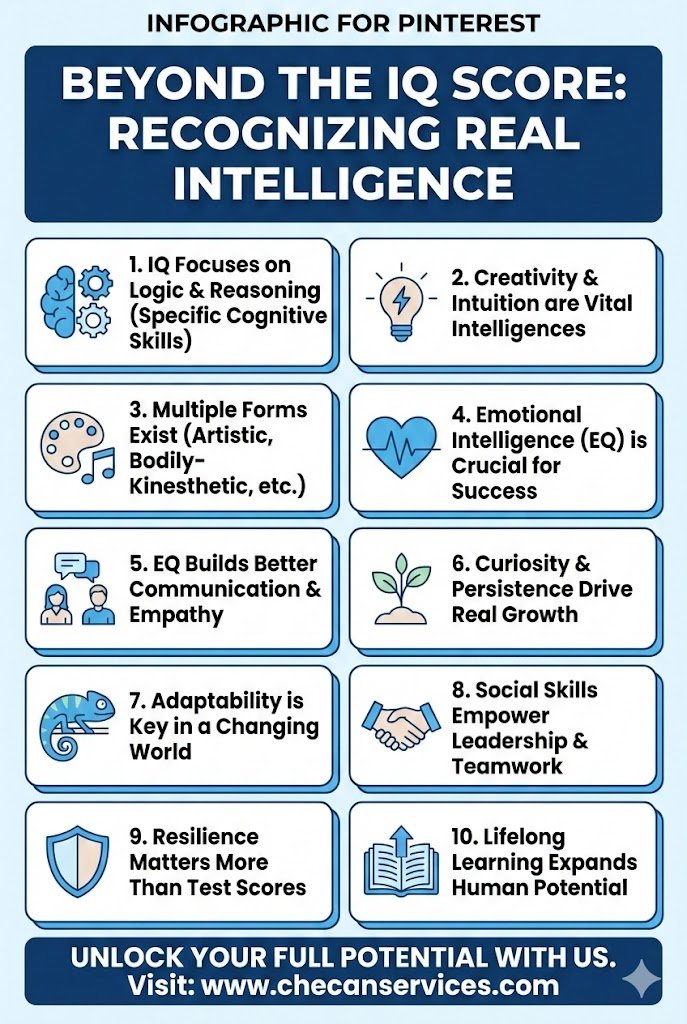
For decades, IQ has been treated like the gold standard of intelligence. A single number, neat and tidy, that supposedly tells us how “smart” someone is. But here’s the thing: real intelligence is far more complex, nuanced, and human than any standardized test score can capture.
If you’ve ever known someone who struggled in school but thrived in business, relationships, or creative pursuits, you’ve already seen the limits of IQ in action.
What IQ Really Measures—and What It Misses
IQ tests are designed to measure specific cognitive abilities such as logical reasoning, pattern recognition, memory, and verbal comprehension. These skills matter, especially in academic and technical settings. But they represent only a narrow slice of human potential.
What IQ often misses are qualities like creativity, emotional awareness, adaptability, leadership, intuition, and resilience. These traits don’t show up neatly on a test, yet they play a massive role in real-world success and fulfillment.
Intelligence Comes in Many Forms
Psychologist Howard Gardner challenged the idea of a single, fixed intelligence by proposing the theory of multiple intelligences. He suggested that people can be intelligent in different ways—linguistic, logical-mathematical, musical, interpersonal, intrapersonal, spatial, bodily-kinesthetic, and more.
Think about it. A gifted musician may not excel at algebra. A therapist with deep emotional insight may never top a logic test. Yet both are undeniably intelligent in ways that shape the world around them.
Emotional and Social Intelligence Matter More Than Ever
In today’s interconnected world, emotional intelligence (EQ) is becoming just as valuable—if not more so—than raw cognitive ability. EQ includes skills like empathy, self-awareness, communication, and conflict resolution.
These abilities influence leadership, teamwork, relationships, and mental well-being. A person with a high IQ but low emotional intelligence may struggle to collaborate, while someone with average IQ and strong EQ can inspire teams, build trust, and navigate complexity with ease.
Real-Life Success Isn’t Built on Test Scores Alone
Some of the most influential entrepreneurs, artists, and innovators were not defined by exceptional IQ scores. What set them apart was curiosity, persistence, creative thinking, and the willingness to learn from failure.
Modern life rewards people who can adapt, think laterally, and connect ideas across disciplines. Intelligence, in this sense, becomes less about how fast you solve a problem and more about how thoughtfully you approach it.
Key Takeaways to Rethink Intelligence
- IQ measures only a narrow band of cognitive skills
- Intelligence shows up in emotional, creative, and social abilities
- Real-world success depends on adaptability and self-awareness
- Everyone has unique strengths that tests can’t always capture
When we move beyond IQ, we open the door to a more inclusive and empowering understanding of human potential—one that values growth, diversity, and lifelong learning.
If you enjoy exploring ideas like personal growth, mindset, and modern intelligence, you may want to discover thoughtful reads that expand these perspectives. Browse the inspiring ebooks by Louise Blount available on Apple Books and find a title that resonates with where you’re headed next.