When we talk about children’s success, the word talent often steals the spotlight. We admire the child who reads early, solves math problems quickly, or excels at sports with ease. But there’s another quality—often quieter, sometimes messier—that can have an even greater impact over time: curiosity.
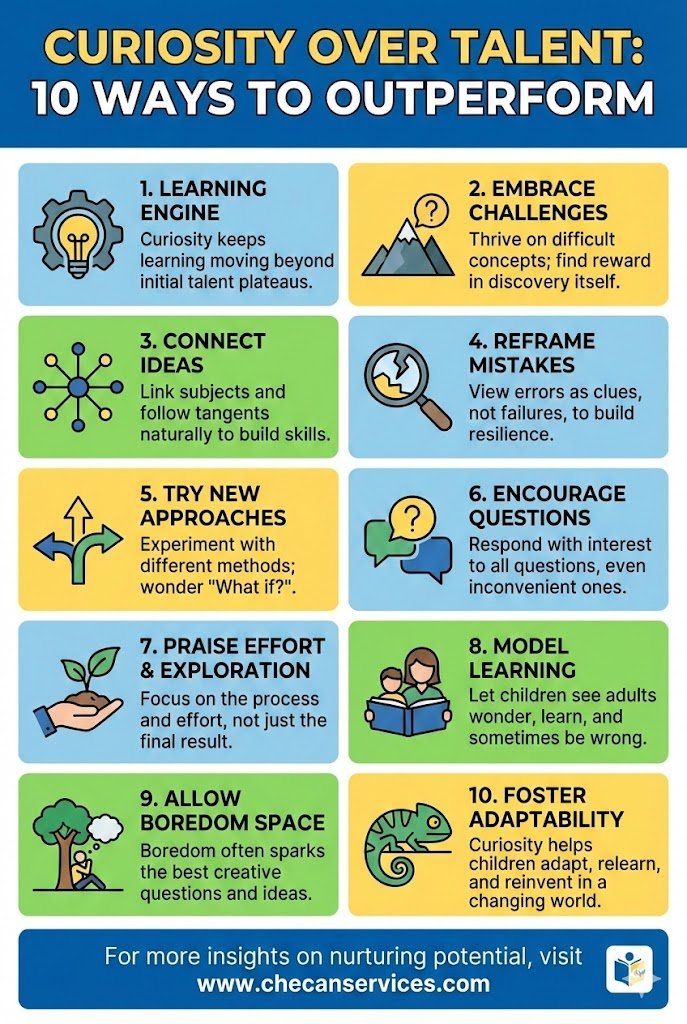
Curiosity is the engine that keeps learning moving long after natural talent plateaus. While talent can give children a head start, curiosity determines how far they’ll ultimately go.
Why Talent Alone Isn’t Enough
Talent tends to work best in familiar territory. A naturally gifted child may shine early, but without the desire to explore, question, and experiment, progress can slow. We’ve all seen examples: a bright student who coasts for years and then struggles when learning finally becomes challenging.
Curiosity, on the other hand, thrives on challenge. Curious children want to know why something works, not just how to get the right answer. They’re more willing to wrestle with difficult concepts because discovery itself feels rewarding.
How Curiosity Builds Stronger Learners
Curious children don’t wait to be told what to learn next. They ask questions, follow tangents, and connect ideas across subjects. A child fascinated by insects might naturally develop skills in reading, observation, and even data collection—without realizing they’re “studying.”
This mindset builds resilience. When mistakes happen, curiosity reframes them as clues instead of failures. Instead of thinking, I’m not good at this, the child wonders, What happens if I try a different approach? That shift can make all the difference in long-term growth.
Encouraging Curiosity at Home and School
The good news? Curiosity isn’t something only a few children are born with—it can be nurtured.
Simple changes can have a big impact:
- Respond to questions with interest, even when they come at inconvenient times.
- Praise effort and exploration rather than just results.
- Let children see adults learning, wondering, and sometimes being wrong.
- Allow space for boredom—it often sparks the best questions.
For example, instead of correcting a child immediately, you might ask, “What do you think would happen if…?” That invitation to think builds confidence and independence.
Curiosity in a Fast-Changing World
Looking ahead, curiosity may matter more than ever. Many of the jobs today’s children will hold don’t even exist yet. Talent tied to a single skill can become outdated, but curiosity adapts. It pushes children to keep learning, relearning, and reinventing themselves as the world changes.
In this sense, curiosity isn’t just a learning trait—it’s a life skill. It helps children navigate uncertainty with interest instead of fear.
Key Takeaways for Parents and Educators
Curiosity can outperform talent because it fuels lifelong learning, resilience, and adaptability. When children are encouraged to wonder, explore, and ask questions, they don’t just become better students—they become confident thinkers.
If you’re looking for thoughtful, story-driven resources that gently spark curiosity and reflection in young readers, you may enjoy exploring the ebooks available on Apple Books by Louise Blount. They’re a wonderful way to nurture imagination and a love of learning—one page at a time.