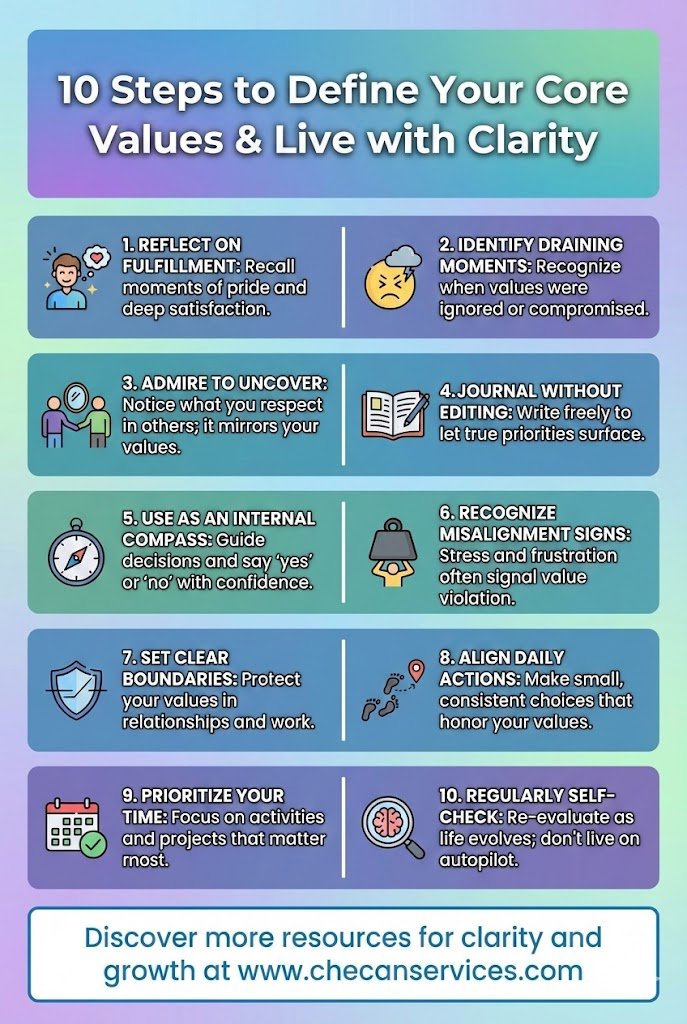
Have you ever made a decision that looked right on paper but felt completely wrong afterward? That quiet discomfort is often your core values trying to get your attention. Understanding your core values isn’t just a personal development exercise—it’s a practical way to bring clarity, confidence, and consistency into your everyday life.
What are core values, really?
Core values are the beliefs and principles that guide how you live, work, and relate to others. They influence your choices even when you’re not consciously aware of them. Values like honesty, freedom, growth, compassion, or stability quietly shape how you define success, handle conflict, and prioritize your time.
For example, if you value independence but find yourself in a role with constant micromanagement, frustration is almost inevitable. The issue isn’t just the job—it’s the misalignment with what matters most to you.
Why understanding your values changes everything
When your life aligns with your core values, decisions become simpler. You’re less likely to second-guess yourself or feel pulled in too many directions. Values act like an internal compass, helping you say “yes” with confidence and “no” without guilt.
Consider relationships. If respect is a core value and you repeatedly tolerate dismissive behavior, tension builds—not because you’re overly sensitive, but because your values are being violated. Recognizing this helps you set clearer boundaries and make healthier choices.
How to uncover your core values
You don’t need a dramatic life overhaul to identify your values. Start with reflection:
- Think about moments when you felt proud, fulfilled, or deeply satisfied. What values were being honored?
- Recall times you felt angry or drained. Which values were ignored or compromised?
- Notice patterns in what you admire in others—it’s often a mirror of what you value yourself.
Journaling can be especially powerful here. Writing without editing allows your true priorities to surface. Over time, you’ll notice a few themes repeating. Those are clues to your core values.
Living your values in everyday life
Understanding your values is only the first step; living them is where transformation happens. This doesn’t mean making drastic changes overnight. It can be as simple as adjusting how you spend your weekends, the projects you accept, or the conversations you engage in.
If growth is a core value, you might commit to learning something new each month. If connection matters most, you may prioritize deeper conversations over a packed social calendar. Small, consistent actions create alignment—and alignment creates peace.
Key takeaways
- Core values guide decisions, relationships, and long-term satisfaction
- Misalignment often shows up as stress, frustration, or self-doubt
- Reflection and journaling are powerful tools for discovering what matters most
- Living your values starts with small, intentional choices
Looking ahead
As life evolves, your understanding of your values can deepen. Checking in with yourself regularly ensures you’re not living on autopilot. If you’re ready to explore personal growth, clarity, and intentional living more deeply, you may find inspiration in thoughtful reads available on Apple Books. Explore insightful ebooks by Louise Blount and take your next step toward a values-driven life by browsing her collection here.