Have you ever opened a streaming app, scrolled for 20 minutes, and then closed it without watching anything?
That’s not laziness. That’s choice overload.
In business, especially online, offering too many options can quietly damage your conversions. More products, more packages, more pricing tiers — it feels like you’re giving customers freedom. In reality, you may be overwhelming them into doing nothing at all.
Let’s explore why too many choices reduce conversions and how you can design smarter, simpler offers that actually sell.
The Psychology Behind Choice Overload
When customers land on your website, they’re already making mental calculations.
Is this trustworthy?
Is this worth my time?
Is this the right product for me?
Now imagine they’re faced with 27 product variations, 5 pricing plans, and endless customization options.
Instead of feeling empowered, they feel stressed.
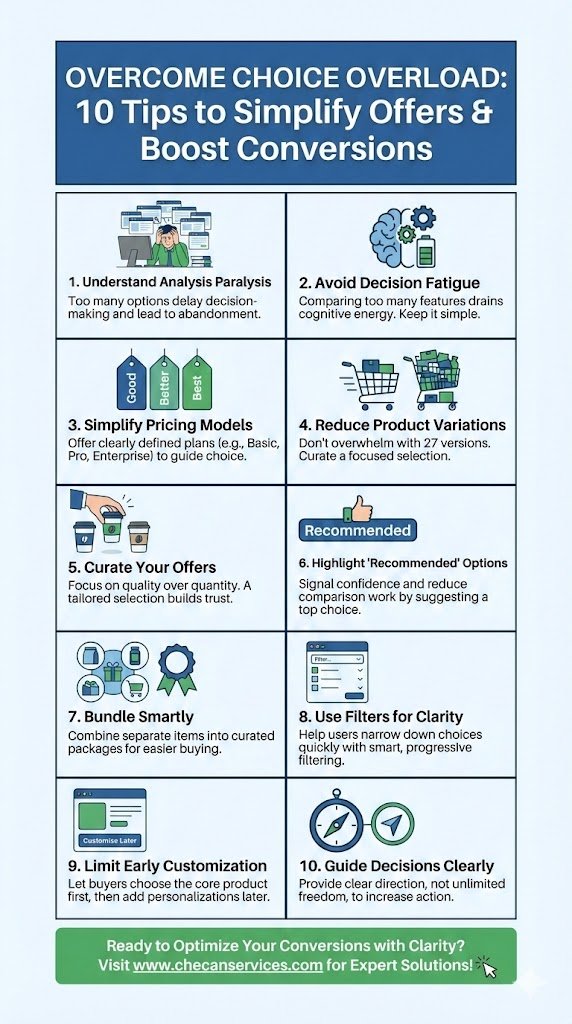
This is known as “analysis paralysis.” When the brain has too many options to compare, it delays decision-making. And in e-commerce or digital marketing, delay usually means abandonment.
The future of high-converting websites isn’t about adding more. It’s about simplifying decisions.
More Options Create More Doubt
It seems logical: more choices = higher chance someone finds something they like.
But in reality, more choices often create:
- Fear of choosing the wrong option
- Regret anticipation (“What if there’s a better one?”)
- Decision fatigue
When customers hesitate, conversions drop.
Think about subscription services. If you offer Basic, Standard, Pro, Premium, Elite, and Enterprise, customers must compare features line by line. Many will leave instead of deciding.
But if you offer three clearly defined plans — Good, Better, Best — decisions feel manageable.
Simplicity converts.
The Illusion of “More Value”
Many businesses believe that expanding product lines increases revenue. Sometimes it does. But often, it fragments attention.
Imagine walking into a café that sells 120 different drinks. It sounds impressive — until you’re standing in line trying to decode the menu.
Now compare that to a café that specializes in 8 carefully crafted drinks. The experience feels curated. Intentional. Confident.
Online stores work the same way. A focused offer builds trust. A cluttered offer creates confusion.
In the future, successful brands will win not by offering more — but by offering clarity.
How to Reduce Choices Without Losing Sales
Here’s the good news: you don’t have to eliminate products. You just need to guide decisions better.
1. Highlight a “Recommended” Option
When customers see a clear suggestion, they relax. It signals confidence and reduces comparison work.
Many SaaS companies label one plan as “Most Popular.” That small design choice dramatically improves conversions.
2. Bundle Smartly
Instead of selling 10 separate items, bundle them into 2–3 curated packages. It simplifies the buying journey while increasing perceived value.
Customers want direction, not homework.
3. Use Filters Wisely
If you run an online store with many products, use smart filters to narrow choices quickly. The goal is to reduce visible options at any one time.
Think progressive disclosure — reveal information as needed.
4. Limit Customization at the Start
Too many customization options early in the funnel can overwhelm buyers. Let them choose the core product first. Add personalization later.
Step-by-step decisions feel easier than all-at-once decisions.
What This Means for Your Business
Attention spans are shrinking. Cognitive load matters more than ever.
The businesses that thrive in the coming years will understand this: customers don’t want unlimited freedom. They want guided clarity.
Reducing options doesn’t reduce opportunity — it increases action.
If your conversion rates are lower than expected, don’t immediately assume you need more traffic. Look at your offer structure first.
Ask yourself:
- Can I simplify my pricing?
- Can I reduce visible options?
- Can I guide decisions more clearly?
Often, small simplifications lead to big revenue gains.
Key Takeaways
Too many choices reduce conversions because they create stress, doubt, and delay.
Simplicity builds confidence.
Clarity builds trust.
Guided decisions build sales.
As digital markets grow more competitive, businesses that remove friction will outperform those that overwhelm.
If you’re interested in understanding how small psychological shifts can create powerful results in business and personal growth, you may enjoy exploring Louise Blount’s books. Her insights help turn complex ideas into practical strategies you can apply immediately.
Sometimes, less truly is more.