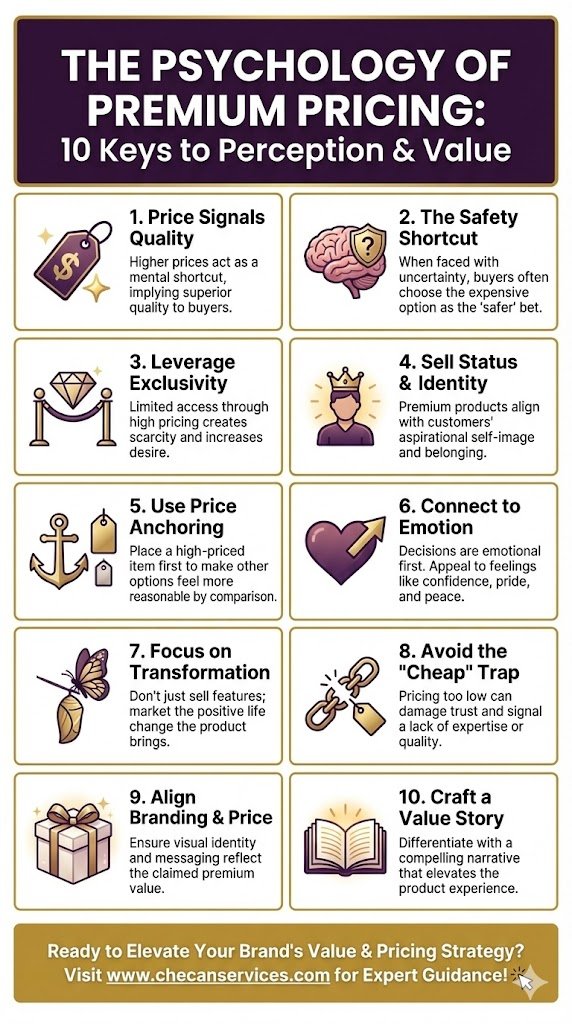
Why do people happily pay $5 for a cup of coffee at Starbucks when they could make one at home for cents? Why do shoppers line up for the newest iPhone from Apple instead of choosing a cheaper alternative?
The answer lies in the psychology of premium pricing.
Premium pricing isn’t just about charging more. It’s about shaping perception, building trust, and positioning a product or service as worth the higher cost. And in today’s crowded marketplace, understanding this psychology can make the difference between blending in and standing out.
Let’s break down what’s really happening in the buyer’s mind.
Price as a Signal of Quality
Most people assume higher price equals higher quality.
Even if we know logically that price and quality don’t always match, our brains use price as a shortcut. When faced with two similar products, we often choose the more expensive one because it feels safer.
Think about buying skincare. A $12 serum might work just as well as a $90 one. But the $90 product often comes in elegant packaging, uses refined language, and positions itself as “clinical” or “luxury.” The higher price reinforces the story.
This is called price-quality inference. When information is limited, price becomes a signal.
The Power of Exclusivity
Premium pricing creates a sense of exclusivity.
If something is expensive, fewer people can access it. That scarcity increases desirability. Brands like Rolex don’t just sell watches — they sell status, achievement, and belonging to a select group.
Exclusivity triggers a psychological response tied to identity. People don’t just buy products; they buy who they believe they become by owning them.
In the future, as markets grow more saturated, this identity-driven purchasing will likely become even stronger. Consumers will seek brands that align with their values, lifestyle, and aspirations — and they’ll pay more for that alignment.
Anchoring: Making Premium Feel Reasonable
Ever noticed how restaurants place the most expensive item at the top of the menu?
That’s anchoring at work.
If the first steak you see costs $85, then the $48 option suddenly feels reasonable. Even if $48 is still expensive, your brain compares it to the anchor.
Tech companies use this strategy masterfully. When Tesla releases a high-end model first, it makes their “entry-level” version feel accessible by comparison.
Premium pricing doesn’t always mean selling the most expensive option. Sometimes it means using a premium tier to reframe everything else.
Emotional Justification Over Logic
Most buying decisions are emotional, not rational.
People justify premium purchases after they’ve already decided emotionally. Someone buying noise-canceling headphones for $400 may tell themselves it’s about sound quality. But deeper down, it’s about comfort, focus, productivity, or even self-reward.
Premium pricing works best when it connects to emotion: confidence, relief, pride, peace of mind.
As automation increases and basic products become commoditized, emotional differentiation will matter more than ever. The brands that win won’t just offer better features — they’ll offer better feelings.
The Risk of Going Too Cheap
Interestingly, pricing too low can hurt trust.
If a consultant charges far below market rate, potential clients may question their expertise. If a luxury-looking product is surprisingly cheap, it can create doubt.
In some cases, raising prices can increase demand — not decrease it. The higher price can signal competence, confidence, and demand.
That doesn’t mean every product should be premium. It means pricing must match positioning.
What This Means for Businesses and Creators
If you’re building a brand, launching a course, selling a service, or even writing a book, premium pricing starts with perception.
Ask yourself:
- Does your branding reflect the value you claim?
- Does your messaging communicate transformation, not just features?
- Are you solving a meaningful problem?
In the coming years, as AI tools make production easier and competition increases, differentiation will shift from “what you sell” to “how you position it.”
Premium pricing will belong to those who craft clear value stories and create memorable experiences.
Key Takeaways
Premium pricing isn’t about charging more for the sake of it.
It’s about psychology — perception of quality, exclusivity, emotional connection, and strategic comparison.
When done well, it elevates both brand and buyer. It creates confidence. It signals value. It builds loyalty.
And if you’re interested in exploring how perception, behavior, and decision-making shape personal growth and success, you might enjoy browsing Louise Blount’s books, where these themes are explored in practical and thought-provoking ways.