We live in an age of constant messaging. Ads follow us across apps. Influencers compete for attention. Even everyday conversations often feel like subtle sales pitches. In this environment, persuasion is everywhere.
But here’s the twist: clarity is what actually wins.
When you strip away the noise, the messages that stick aren’t the flashiest or most emotionally manipulative. They’re the clearest. Whether you’re leading a team, building a brand, writing online, or simply trying to be understood, clarity consistently outperforms persuasion.
Let’s explore why.
Clarity Builds Trust Faster Than Persuasion
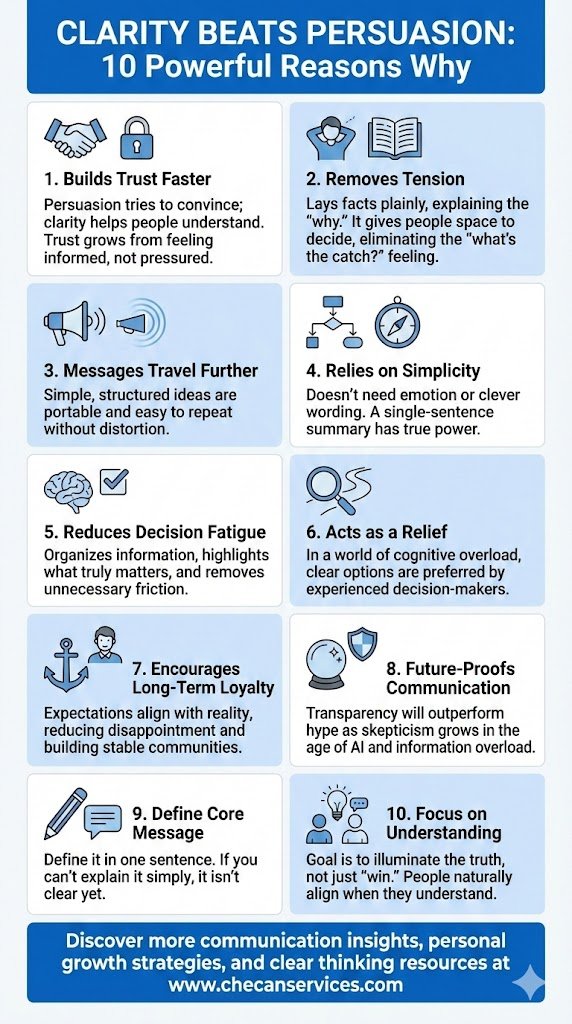
Persuasion tries to convince. Clarity helps people understand.
There’s a big difference.
When someone feels they are being persuaded, their guard goes up. They start evaluating your motive. Are you selling something? Are you hiding something? What’s the catch?
Clarity removes that tension. It lays the facts out plainly. It explains the “why” behind the idea. It gives people space to decide for themselves.
In business, this might look like clearly explaining pricing instead of using confusing tiers and “limited-time offers.” In leadership, it could mean being honest about company challenges instead of sugarcoating them. In relationships, it’s saying exactly what you feel instead of hinting and hoping the other person figures it out.
Trust grows when people feel informed, not pressured.
Clear Messages Travel Further
Think about the ideas that spread easily. They are simple. Easy to repeat. Easy to understand.
Persuasive messages often rely on emotion, urgency, or clever wording. But clarity relies on structure and simplicity. When someone can summarize your message in one sentence, it has power.
For example, consider health advice. “Drink more water” is clear. “Optimize your hydration strategy for improved metabolic performance” may sound impressive, but it won’t spread as easily.
Clarity makes your message portable. Others can carry it forward without distorting it.
In the future, as attention spans shrink and information overload increases, clarity will only become more valuable. The simpler and clearer your communication, the more likely it will survive the scroll.
Clarity Reduces Decision Fatigue
Modern life demands constant decision-making. What to buy. What to read. Who to follow. What to believe.
When a message is overly persuasive, it often adds complexity: emotional hooks, exaggerated claims, layered arguments. That can overwhelm people.
Clarity does the opposite. It organizes information. It highlights what truly matters. It removes unnecessary friction.
Imagine choosing between two online courses. One page is packed with testimonials, countdown timers, bold claims, and flashy graphics. The other clearly outlines what you’ll learn, how long it takes, who it’s for, and what it costs.
Most people, especially experienced buyers, gravitate toward the clear option.
In a world of cognitive overload, clarity feels like relief.
Clarity Encourages Long-Term Loyalty
Persuasion is often focused on the short-term win. Make the sale. Get the click. Secure the agreement.
Clarity is built for the long term.
When people clearly understand what they’re getting into, expectations align with reality. That reduces disappointment. It reduces refunds. It reduces resentment.
Businesses that communicate clearly tend to build loyal communities instead of one-time customers. Leaders who communicate clearly build stable teams instead of fragile compliance.
Looking ahead, this matters more than ever. As consumers become more skeptical and more informed, transparency will outperform hype.
Clarity isn’t just ethical — it’s strategic.
How to Lead with Clarity
If you want to prioritize clarity over persuasion, start here:
1. Define your core message in one sentence.
If you can’t explain it simply, it isn’t clear yet.
2. Remove unnecessary language.
Cut buzzwords. Cut exaggerations. Say what you mean.
3. Answer obvious questions upfront.
What is it? Who is it for? What does it cost? What happens next?
4. Focus on understanding, not winning.
Your goal is not to “beat” objections. It’s to illuminate the truth.
Over time, you’ll notice something interesting. You won’t need to push as hard. When people understand you, many will naturally align with you.
What This Means Moving Forward
The future belongs to communicators who value clarity.
As AI-generated content increases and persuasive tactics become more sophisticated, people will crave something refreshing: honesty, simplicity, and transparency.
Clarity is not boring. It’s powerful. It signals confidence. It shows you’re not afraid of scrutiny. It invites collaboration instead of coercion.
In your writing, your business, and your everyday conversations, experiment with this shift. Instead of asking, “How can I convince them?” try asking, “How can I make this clearer?”
You may find that persuasion becomes unnecessary.
If you’re interested in exploring deeper insights about communication, personal growth, and clear thinking, you might enjoy browsing Louise Blount’s books, where thoughtful ideas are presented with refreshing simplicity.