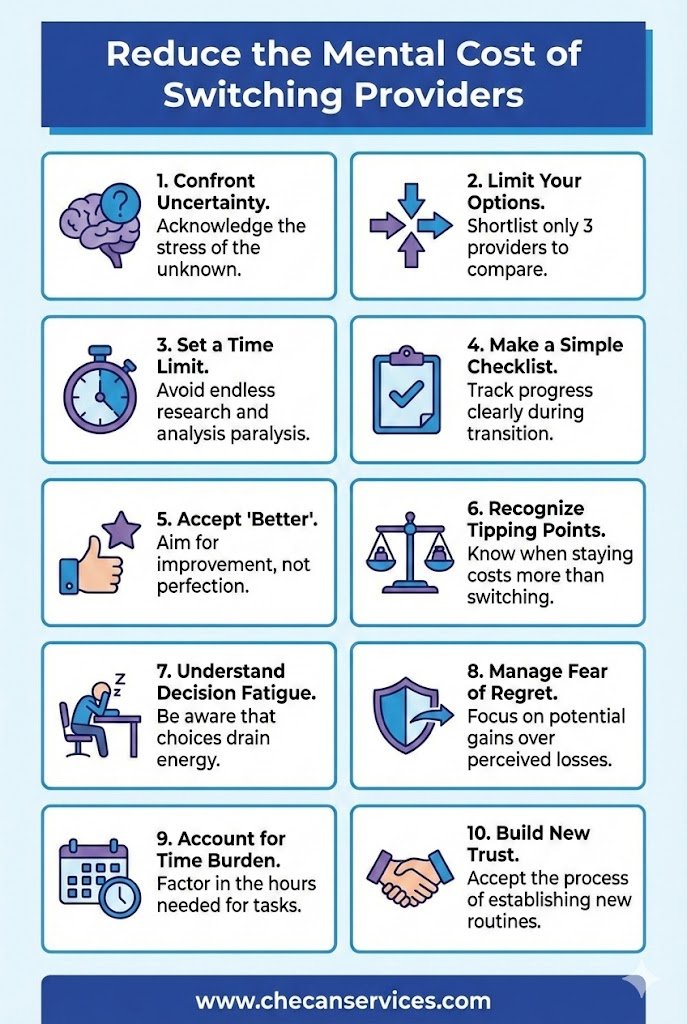
Switching service providers sounds simple on paper. You compare prices, read a few reviews, click a few buttons, and move on.
But in reality, switching banks, insurance companies, internet providers, or even healthcare providers comes with a hidden mental cost. And that cost is often higher than we expect.
Let’s break down what really happens in our minds when we decide to make a change.
Why Switching Feels More Exhausting Than It Should
At its core, switching providers forces you to confront uncertainty.
When you leave a familiar service, even if it’s not perfect, you give up predictability. You know how your current provider works. You know how long their support takes. You know their quirks.
Changing means stepping into the unknown.
That uncertainty activates stress. Your brain prefers familiarity because it feels safer. Even a mediocre but predictable service often feels more comfortable than a potentially better but unfamiliar one.
Decision Fatigue Is Real
Think about the last time you tried to switch mobile carriers or health insurance.
You probably faced:
- Endless pricing plans
- Complicated terms and conditions
- Fine print you weren’t sure you fully understood
- Fear of hidden fees
Every decision requires mental energy. Comparing features, reading reviews, evaluating risks — it all adds up.
By the time you’re ready to commit, you’re mentally drained.
This is called decision fatigue. And it’s one of the biggest invisible costs of switching providers.
The Fear of Regret
Another powerful mental factor is anticipated regret.
“What if I switch and it’s worse?”
“What if I lose some benefit I didn’t notice before?”
“What if customer service is terrible?”
Even when the current provider isn’t ideal, the fear of making the wrong move keeps many people stuck. In behavioral economics, this is closely related to loss aversion — the idea that losses feel stronger than gains.
You might save money by switching. But the risk of losing something familiar feels more painful than the potential gain feels rewarding.
Time as a Hidden Psychological Burden
Switching providers isn’t just about money. It’s about time.
You have to:
- Fill out forms
- Transfer information
- Update payment details
- Inform other services
- Monitor the transition
Each of these tasks lingers in the back of your mind.
Until everything is fully transferred and running smoothly, your brain keeps it on the “open loop” list — unfinished business that quietly drains your attention.
That mental background noise can be surprisingly heavy.
Identity and Trust Play a Role
Sometimes switching providers isn’t just practical — it feels personal.
If you’ve been with the same bank for 15 years, it becomes part of your routine and identity. There’s an emotional familiarity there.
Trust builds over time. Even if it’s imperfect, it feels stable.
Breaking that relationship can feel like starting over socially — rebuilding trust, learning new systems, adjusting to new interfaces. It’s subtle, but it matters.
When the Mental Cost Stops Being Worth It
Here’s the key: mental cost is temporary, but long-term dissatisfaction compounds.
If your provider consistently frustrates you, overcharges you, or limits your growth, the mental energy you save by staying may actually cost more over time.
There’s a tipping point where the short-term stress of switching becomes smaller than the long-term stress of staying stuck.
Recognizing that moment is empowering.
How to Reduce the Mental Cost of Switching
You don’t have to eliminate the stress completely. But you can reduce it.
Start by narrowing your options. Instead of comparing 15 providers, shortlist 3.
Set a time limit for research. Endless comparison increases anxiety.
Make a simple checklist so you can clearly see progress during the transition.
And most importantly, remind yourself that perfection isn’t required. “Better” is enough.
What This Means Going Forward
In a world with more options than ever, switching providers will remain a common part of life.
Understanding the mental cost helps you make more intentional decisions. Instead of feeling irrationally resistant to change, you can recognize what’s happening psychologically.
Sometimes staying is the right move.
Sometimes switching opens new opportunities.
The key is awareness.
If you enjoy exploring how everyday decisions shape your mindset and future, you may find thoughtful insights in Louise Blount’s books. Her work gently explores growth, change, and the inner shifts that move us forward.