Have you ever sent an email, proposal, or message and heard… nothing?
It’s easy to assume silence means rejection. But in most cases, it doesn’t. The psychology of follow-ups tells a very different story — one rooted in human attention, memory, and decision-making patterns. When done thoughtfully, follow-ups aren’t annoying. They’re powerful.
Let’s explore why they work and how you can use them more effectively in business and everyday life.
Why People Don’t Respond the First Time
Most people are overwhelmed.
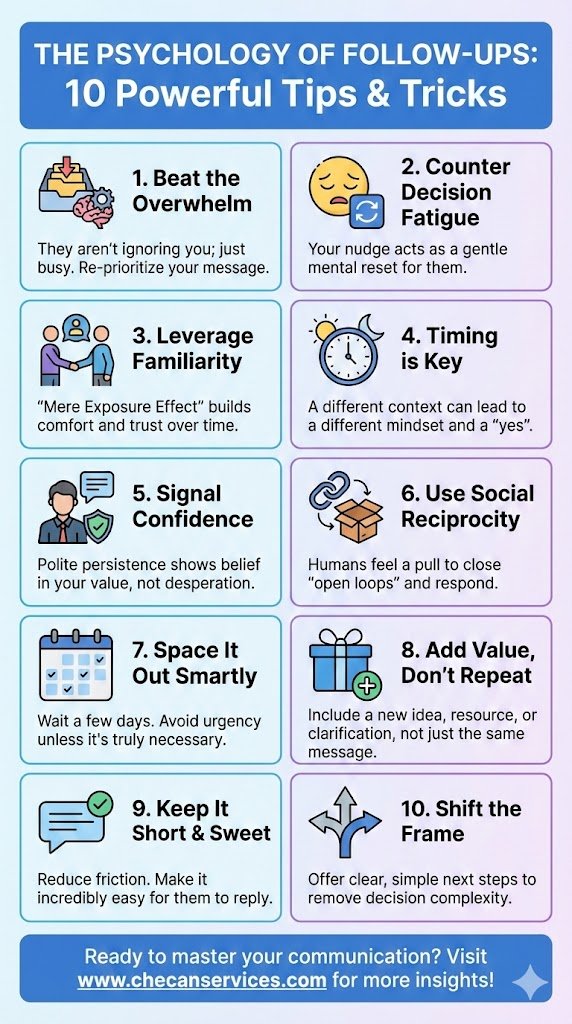
Between overflowing inboxes, constant notifications, and competing priorities, messages slip through the cracks. It’s rarely personal. The human brain is wired to prioritize what feels urgent, emotional, or immediately rewarding. If your message doesn’t hit one of those triggers, it might get postponed — and forgotten.
There’s also something called “decision fatigue.” When someone receives a message that requires thought, action, or commitment, they may delay responding simply because their mental energy is low. Your follow-up acts as a gentle reset.
In other words, the first message introduces the idea. The follow-up brings it back into focus.
The Power of Familiarity
Psychologists call it the “mere exposure effect.” The more we see something, the more comfortable we feel with it.
Follow-ups increase familiarity. When your name or idea appears again, it feels less risky and more recognizable. This is especially important in networking, sales, and creative work.
Think about it this way: If someone sees your proposal once, it’s an interruption. If they see it twice or three times, it starts to feel legitimate.
Familiarity builds trust — and trust increases response rates.
Timing Changes Everything
One reason follow-ups succeed is timing.
Your original message might have arrived at the worst possible moment. Maybe the recipient was in a meeting, traveling, or distracted. A follow-up hits their inbox at a different emotional and mental state.
Psychology shows that context influences decisions. A “no” on Monday morning might become a “yes” on Thursday afternoon when stress levels are lower.
Strategic follow-ups don’t pressure people. They give them another opportunity to say yes.
Persistence Signals Confidence
There’s a subtle psychological signal behind a well-crafted follow-up: confidence.
When you follow up calmly and professionally, you communicate belief in your value. You show that you respect your time and theirs.
Contrast that with silence. If you never follow up, it can unintentionally signal doubt.
Of course, there’s a balance. Persistence should never feel aggressive. The tone matters. A short, friendly message like:
“Just checking in to see if you had a chance to review this.”
works far better than a frustrated nudge.
Confidence attracts response.
Social Norms and Reciprocity
Humans are wired for reciprocity. When someone reaches out politely more than once, we feel a subtle social pull to respond.
It’s not manipulation. It’s social wiring.
A respectful follow-up reminds the other person that there’s an open loop. Psychologically, people prefer to close open loops. It creates mental relief.
That’s why a second or third message often triggers a response — even if it’s a simple “Thanks, but not right now.”
Closure feels good.
How to Follow Up the Smart Way
Understanding the psychology is one thing. Applying it is another.
Here are practical strategies:
1. Space it out.
Wait a few days before your first follow-up. Urgency can feel pushy unless the situation truly requires it.
2. Add value.
Instead of repeating your original message, include something helpful — a new idea, a resource, or clarification.
3. Keep it short.
Long follow-ups create friction. Make it easy to reply.
4. Shift the frame.
Try offering a clear next step: “Would Tuesday or Wednesday work better?”
When you remove decision complexity, you increase response probability.
What This Means for Your Future Success
The biggest mistake people make is giving up too early.
Studies in sales and outreach consistently show that most responses happen after the second or third contact — not the first. Yet many people stop after one attempt.
In the future, as communication becomes even more crowded, strategic follow-ups will become more important, not less. Attention is the new currency. Reminding someone — respectfully — keeps you in the game.
Persistence isn’t about pressure. It’s about presence.
If you’re working on improving communication, influence, or confidence, exploring thoughtful resources can deepen your understanding. You might enjoy browsing Louise Blount’s books for practical insights on mindset and personal growth.
The psychology of follow-ups isn’t complicated. It’s human. And when you understand how people think, you stop fearing silence — and start using it strategically.