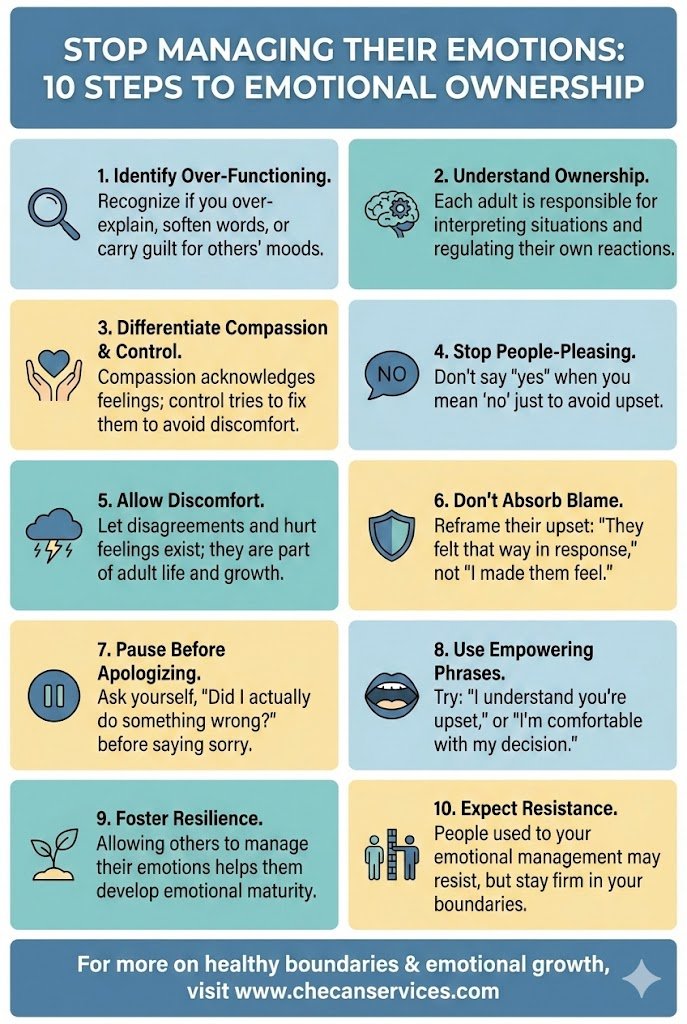
Have you ever found yourself managing someone else’s emotions like it’s your full-time job?
Maybe you soften your words so they won’t get upset. Maybe you over-explain so they won’t feel left out. Or maybe you carry guilt for someone else’s bad mood, even when you didn’t cause it.
Here’s a powerful truth: grown adults are responsible for their own feelings.
When we truly understand that, our relationships shift in healthier, more freeing ways.
What Emotional Ownership Really Means
Emotional ownership is simple in theory but challenging in practice.
It means each person is responsible for:
- How they interpret situations
- How they react
- How they regulate their emotions
- How they communicate their needs
You are responsible for your behavior, your words, and your intentions. But you are not responsible for managing another adult’s emotional response.
For example, if you decline an invitation politely and someone feels rejected, their feeling is valid—but it’s still theirs to process. You didn’t “cause” their emotion; you made a choice. How they interpret that choice belongs to them.
Why We Struggle to Let Go
Many of us were raised to believe that keeping the peace equals being kind.
We learned to smooth over tension, avoid conflict, and anticipate others’ emotional reactions. In workplaces, friendships, and romantic relationships, this can turn into emotional over-functioning.
You might say yes when you mean no.
You might apologize for things that aren’t your fault.
You might feel anxious anytime someone seems unhappy.
The problem? This creates emotional dependency.
When one adult becomes responsible for another adult’s feelings, resentment builds quietly. Over time, relationships feel heavy instead of mutual.
The Difference Between Compassion and Control
Letting someone own their feelings doesn’t mean you become cold or dismissive.
Compassion says, “I see that you’re upset.”
Control says, “Let me fix this so you won’t be upset.”
There’s a difference.
Healthy relationships allow space for discomfort. Disagreements, misunderstandings, and hurt feelings are part of adult life. Growth happens when people learn to sit with their emotions instead of outsourcing them.
Think about it this way: if someone never has to manage disappointment, frustration, or rejection, how will they build resilience?
What Happens When You Stop Managing Other People’s Emotions
At first, it feels uncomfortable.
People who are used to you carrying emotional weight may resist. They might accuse you of being selfish. They might push harder for reassurance.
But something important starts to happen.
You become clearer.
You speak more honestly.
You set healthier boundaries.
And something even more powerful happens: other adults start developing emotional maturity.
When someone has to process their own reaction instead of blaming you, they grow. They learn to self-reflect. They learn to communicate better. They learn that feelings are signals—not weapons.
Over time, relationships become more balanced. Less walking on eggshells. More direct conversation.
Practical Ways to Encourage Emotional Ownership
If this idea feels new, start small.
Pause before apologizing. Ask yourself: Did I actually do something wrong?
If someone says, “You made me feel…” gently reframe it in your mind: They felt that way in response to what happened.
Use phrases like:
- “I understand you’re upset.”
- “That wasn’t my intention.”
- “I’m comfortable with my decision.”
Notice how none of these take responsibility for the other person’s emotional reaction. They acknowledge, but they don’t absorb.
This shift builds emotional independence on both sides.
What This Means for Your Future Relationships
When adults take ownership of their emotions, relationships become partnerships instead of emotional rescue missions.
There’s more respect.
More accountability.
More emotional safety.
You stop feeling drained by every mood change in the room. You stop trying to predict reactions. You start living more honestly.
And the people who truly value mutual growth will rise to meet you there.
Letting grown adults own their feelings isn’t harsh—it’s empowering. It says, “I trust you to handle your emotions just as I handle mine.”
That trust builds stronger bonds than constant emotional management ever could.
If you’re ready to build healthier boundaries and stronger emotional awareness, exploring thoughtful resources can make all the difference. You might enjoy diving into Louise Blount’s books for deeper insight into personal growth, resilience, and emotional independence.