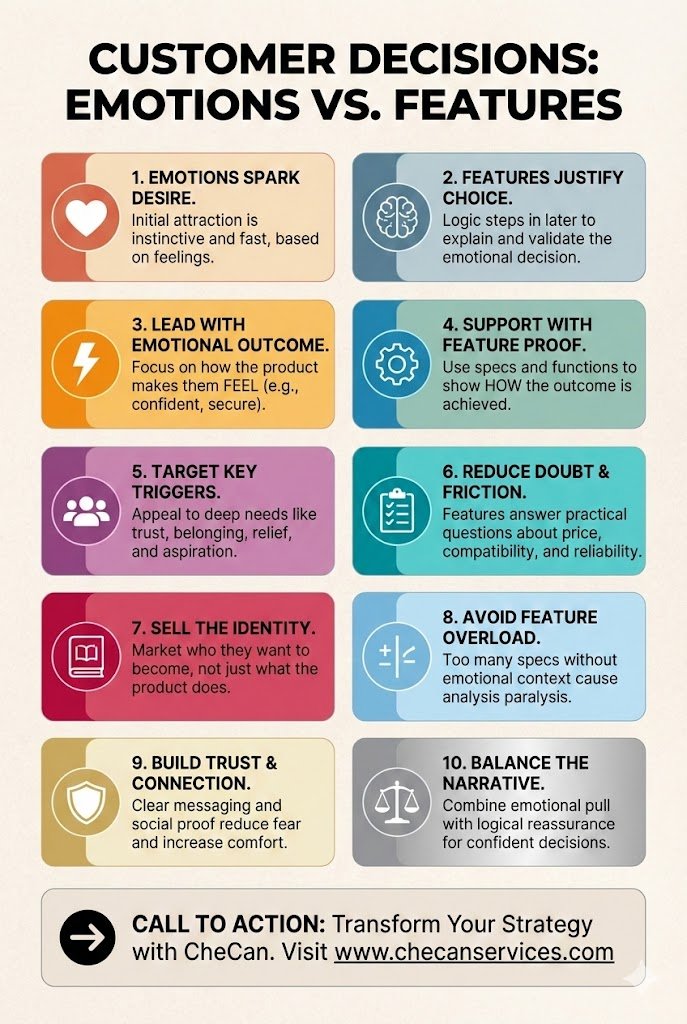
When people say they buy based on logic, they usually mean after the decision has already been made. In reality, most customer decisions start with emotion and end with justification. Understanding the balance between emotions and features is one of the most powerful ways to improve how you market, sell, and communicate your product.
This isn’t about manipulation. It’s about understanding how humans actually decide.
Why Emotions Lead the Buying Process
Emotions are fast. They’re instinctive and deeply tied to survival, identity, and belonging. When someone feels excitement, relief, trust, or confidence, the brain quietly gives a green light to move forward.
Think about the last time you bought something you didn’t strictly need. Maybe it made you feel more productive, more stylish, or more secure. That emotional reaction likely happened before you compared prices or specs.
Brands like Apple don’t just sell phones. They sell creativity, simplicity, and status. The emotional pull happens instantly, and the feature list simply reinforces the choice the customer already wants to make.
The Role Features Actually Play
Features matter, but not in isolation. They help customers explain their decision to themselves and others. This is where logic steps in.
Features answer questions like:
- “Is this worth the price?”
- “Will this solve my problem?”
- “How does this compare to other options?”
For example, when buying a fitness tracker, customers may feel motivated by the idea of becoming healthier. But they’ll still check battery life, compatibility, and accuracy. The emotional desire creates momentum; the features remove friction.
In other words, features reduce doubt. They don’t usually create desire on their own.
Emotional Triggers Customers Respond To
Certain emotions consistently influence buying behavior across industries:
- Trust: Clear messaging, social proof, and transparency reduce fear.
- Belonging: People like to feel part of a group or lifestyle.
- Relief: Products that remove stress or simplify life are incredibly appealing.
- Aspiration: Customers buy into who they want to become.
Nike rarely leads with fabric technology. Instead, it leads with identity, motivation, and personal achievement. The emotional story comes first; the technical details follow.
Why Feature-Only Marketing Often Falls Flat
When marketing focuses only on features, it assumes customers are spreadsheets with wallets. That approach often leads to:
- Information overload
- Price-focused comparisons
- Lower emotional attachment to the brand
Customers may understand what a product does, but not why it matters to them. Without emotional context, features blur together, especially in competitive markets where products look similar on paper.
This is why two nearly identical products can have wildly different sales results.
How to Balance Emotions and Features Effectively
The most effective messaging follows a simple flow:
- Lead with the emotional outcome.
- Support it with relevant features.
- Reinforce trust with proof and clarity.
Instead of saying, “This app has advanced task management,” say, “Feel calm and in control of your day—without forgetting what matters.” Then explain how the features make that possible.
This approach respects the customer’s intelligence while aligning with how decisions naturally happen.
What This Means for Your Business
If you want customers to choose you, focus first on how your product makes their life better, easier, or more meaningful. Features should serve the story, not replace it.
When emotion and logic work together, decisions feel obvious rather than forced.
For readers interested in deeper insights into human behavior, motivation, and decision-making, you may enjoy exploring Louise Blount’s books, which dive into the emotional layers behind everyday choices.