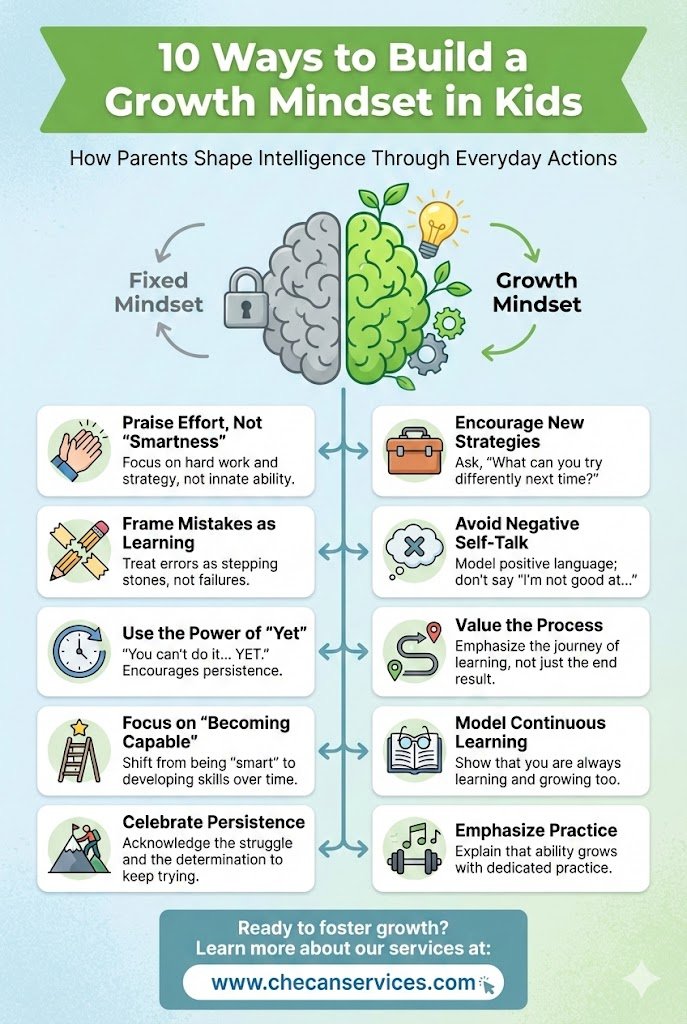
Every parent wants their child to be “smart.” But what if intelligence isn’t something children are simply born with? What if it’s something shaped daily—by words spoken at the dinner table, reactions to mistakes, and how effort is praised or dismissed?
This is where the idea of growth mindset versus fixed mindset comes in, a concept popularized by psychologist Carol Dweck. At its core, it’s not just about how kids think about learning—it’s about how parents frame intelligence itself.
Understanding Growth vs Fixed Mindset at Home
A fixed mindset assumes intelligence is static. Children with this mindset may believe they’re either “good at math” or “not a math person,” and that’s that. When parents unintentionally reinforce this—by saying things like “You’re so smart” or “I was never good at school either”—kids learn to avoid challenges that might expose limits.
A growth mindset, on the other hand, frames intelligence as something that can be developed through effort, strategies, and persistence. When parents say, “You worked really hard on that,” or “What can you try differently next time?” they send a powerful message: ability grows with practice.
The difference may seem subtle, but over time, it reshapes how children approach learning, failure, and even their own potential.
Everyday Parenting Moments That Shape Intelligence
Mindsets aren’t built in big speeches—they’re shaped in small, everyday moments.
Imagine a child brings home a poor test score. A fixed-mindset response might be, “Maybe this subject just isn’t your strength.” A growth-mindset response sounds more like, “Let’s look at what was tricky and figure out how to practice.”
Or think about praise. Telling a child, “You’re a natural artist,” can actually create pressure to always perform well. Praising effort—“I love how you kept trying different ideas”—teaches resilience and curiosity instead of fear of failure.
Even mistakes matter. When parents treat mistakes as learning opportunities instead of disappointments, children become more willing to explore, ask questions, and stretch their abilities.
Why This Matters for the Future
In a world that’s constantly changing, the ability to learn may be more valuable than what we already know. Children raised with a growth mindset are more likely to embrace challenges, adapt to new situations, and recover from setbacks.
This doesn’t mean ignoring results or lowering expectations. It means shifting the focus from “being smart” to “becoming capable.” Over time, children internalize the belief that effort matters—and that belief can influence academic success, career choices, and emotional resilience well into adulthood.
Key Takeaways for Parents
Parents don’t need to be perfect mindset coaches. Awareness alone makes a difference. Listening to how you praise, how you respond to struggles, and how you talk about intelligence can quietly reshape how your child sees themselves.
When children believe they can grow, they’re more likely to try. And when they try, intelligence follows.
If you enjoy exploring ideas around personal growth, mindset, and meaningful change, you may find inspiration in the thoughtfully written ebooks by Louise Blount. Explore her collection on Apple Books here:
👉 Discover Louise Blount’s ebooks on Apple Books
Sometimes, the most powerful growth begins with a simple shift in perspective—and the right words at the right moment.