It sounds logical at first: lower your prices, attract more customers, increase sales.
But in reality, cheap pricing can quietly damage your business in ways that aren’t obvious until it’s too late. While competitive pricing has its place, consistently underpricing your products or services can limit growth, reduce perceived value, and attract the wrong audience.
If you’re building a long-term brand, it’s worth understanding why “cheap” isn’t always smart.
The Hidden Cost of Being the Cheapest
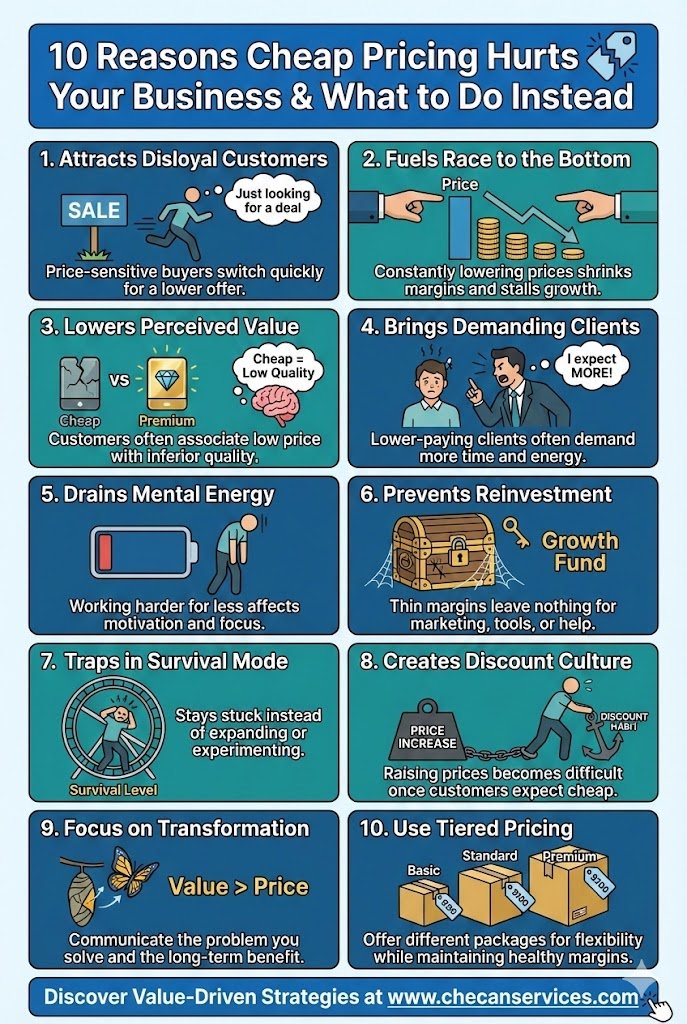
When you position yourself as the most affordable option, you often attract price-sensitive customers. These customers aren’t necessarily loyal. They’re looking for a deal — and the moment someone else offers something cheaper, they’ll switch.
This creates a cycle where you constantly lower prices to stay competitive. Margins shrink. Stress increases. Growth stalls.
Over time, you may find yourself working harder than ever while earning less than you deserve.
Cheap Prices Can Lower Perceived Value
People often associate price with quality. It’s human psychology.
If your product is significantly cheaper than competitors, customers may assume it’s lower quality — even if it isn’t. This is especially true in service-based industries like coaching, consulting, design, or digital products.
Think about it: when you see a $5 course and a $99 course on the same topic, which one do you instinctively trust more?
Price sends a message. Make sure it’s the right one.
You Attract the Wrong Clients
Underpricing can bring in clients who question every detail, negotiate constantly, or expect more than what they paid for.
Ironically, lower-paying customers often demand more time and energy. This leaves less room for serving ideal clients who value your expertise and respect your boundaries.
In the long run, cheap pricing doesn’t just affect revenue — it affects your mental energy and motivation.
It Limits Your Ability to Reinvest
Healthy businesses reinvest profits into marketing, product development, tools, and team support.
If your margins are too thin, there’s nothing left to fuel growth. You may struggle to upgrade software, hire help, or experiment with new ideas.
Growth requires resources. Consistently low pricing can trap your business at the survival level instead of allowing it to expand.
Discount Culture Can Be Hard to Escape
Once customers become used to low prices, raising them becomes difficult.
You risk backlash. You fear losing clients. You second-guess your value.
Businesses that start with sustainable pricing models find it easier to scale confidently. Those that begin with “bargain” positioning often have to rebuild their brand perception later — which takes time and strategy.
What to Do Instead
Instead of competing on price alone, focus on value.
Ask yourself:
- What transformation does my product create?
- What problem does it solve?
- What long-term benefit does it provide?
When you clearly communicate value, you don’t need to be the cheapest option. You need to be the most relevant and effective solution.
You can also introduce tiered pricing. Offer different packages at different price points while maintaining healthy margins. This allows flexibility without undervaluing your work.
Most importantly, build a brand around trust, expertise, and results — not discounts.
Key Takeaways
Cheap pricing may increase short-term sales, but it can:
- Reduce perceived value
- Attract high-maintenance customers
- Shrink profit margins
- Limit reinvestment and growth
- Create long-term brand positioning challenges
A sustainable business isn’t built on being the cheapest. It’s built on delivering meaningful value and charging accordingly.
Looking Ahead
As markets become more competitive, customers are learning to look beyond price. They’re searching for quality, reliability, and real results.
If you position your business around expertise and impact rather than discounts, you create stability. You attract clients who respect your work. And you give yourself room to grow without constantly racing to the bottom.
Pricing is more than a number. It’s a statement about your brand, your confidence, and your future.
If you’re interested in building a stronger mindset around business growth and value-driven success, you might enjoy exploring Louise Blount’s books for deeper insights and practical guidance.