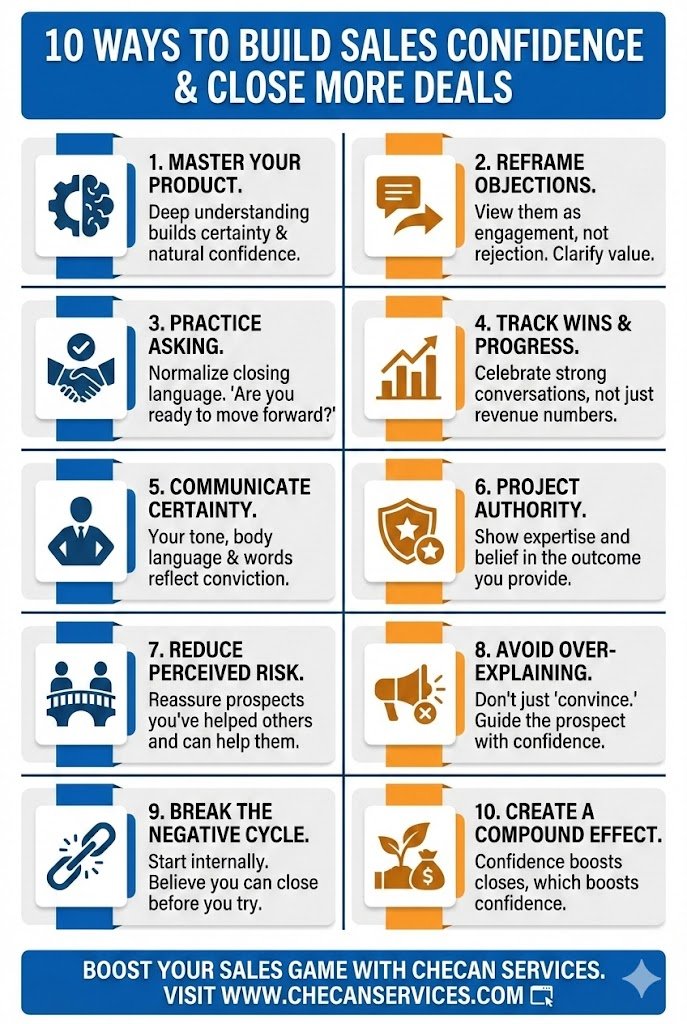
Have you ever noticed how some salespeople seem to close deals effortlessly while others struggle — even when selling the same product? The difference often comes down to one powerful factor: confidence.
Confidence isn’t just a personality trait. It’s a performance driver. And when it comes to closing rates, it can make or break your results.
Let’s explore how confidence directly influences sales success — and how you can develop it to consistently close more deals.
Why Confidence Matters in Sales
Sales is fundamentally about trust.
Before a prospect buys your product or service, they need to believe in two things:
- The solution
- You
If you sound unsure, hesitant, or overly apologetic, prospects subconsciously pick up on it. Even if your offer is excellent, doubt in your delivery creates doubt in their decision.
Confidence communicates:
- Certainty in the value you provide
- Authority in your expertise
- Belief in the outcome
When you believe fully in what you’re selling, your tone, body language, and word choice naturally reflect that conviction.
The Psychology Behind Higher Closing Rates
Buyers are risk-averse. They don’t want to make mistakes.
When you present with confidence, you reduce perceived risk. You signal that you’ve helped others before and can help them too. This reassurance lowers resistance.
Think about two scenarios:
In the first, a salesperson says, “I think this package might work for you.”
In the second, they say, “Based on what you’ve shared, this package is the best fit for your goals.”
The second statement feels decisive and reassuring. That confidence shortens decision time and increases the likelihood of a “yes.”
Higher closing rates often reflect not just better products, but stronger belief.
How Lack of Confidence Hurts Sales Performance
Low confidence can show up in subtle ways:
- Over-explaining features
- Talking too fast
- Discounting too quickly
- Avoiding objections
- Failing to ask for the sale
When you’re unsure, you try to “convince” rather than guide. Prospects sense that energy and may hesitate.
Worse, lack of confidence often leads to self-sabotage. You may assume a deal won’t close before you even try. That mindset affects your preparation, tone, and persistence.
Over time, this creates a cycle: fewer closes → lower confidence → even fewer closes.
Breaking that cycle starts internally.
How to Build Sales Confidence That Improves Closing Rates
Confidence isn’t something you’re born with. It’s built through habits and experience.
1. Master Your Product
Uncertainty disappears when you deeply understand what you’re selling.
Know the benefits inside and out. Be clear on results. Study customer success stories. The more evidence you have that your solution works, the more naturally confident you’ll feel presenting it.
Preparation builds certainty.
2. Reframe Objections
Objections aren’t rejection — they’re engagement.
When someone raises concerns, it means they’re considering the offer seriously. Instead of feeling threatened, view objections as opportunities to clarify value.
This shift alone can dramatically increase your closing confidence.
3. Practice Asking for the Sale
Many sales professionals avoid directly asking for commitment. Confidence grows when you normalize closing language.
Practice phrases like:
- “Are you ready to move forward?”
- “Shall we get started today?”
- “Does this feel like the right next step?”
The more often you ask, the less intimidating it becomes.
4. Track Wins — Not Just Numbers
Don’t measure success only by revenue.
Track:
- Strong conversations
- Positive feedback
- Improved objections handling
- Follow-ups scheduled
When you recognize progress, your internal belief strengthens — and that belief translates into better closing performance.
The Compound Effect of Confidence
Here’s where it gets powerful.
Confidence increases closing rates.
Higher closing rates increase confidence.
That positive loop compounds over time.
A salesperson closing 20% of deals may feel average. But if confidence helps raise that to 30%, the revenue jump can be dramatic — and the internal belief shift even more so.
Small improvements in self-assurance can create massive long-term growth.
What This Means for Your Future Sales Success
In the evolving world of sales — whether in-person, virtual, or through digital funnels — human psychology remains constant. People buy from those they trust and believe in.
Confidence is not about arrogance. It’s about clarity. It’s about knowing your value and communicating it without hesitation.
As markets become more competitive, the sellers who thrive will be those who combine skill with conviction.
The good news? Confidence is trainable. And every conversation is an opportunity to strengthen it.
If you’re looking to deepen your mindset, sharpen your persuasion skills, and build lasting self-belief, exploring Louise Blount’s books can offer practical guidance for personal and professional growth.
Because when you believe in yourself, your closing rates don’t just improve — they transform.