When we think about intelligence in children, we often picture test scores, early reading skills, or how quickly a child can count. But there’s another powerful ingredient that quietly shapes a child’s intelligence long before formal academics take center stage: imagination. Far from being “just play,” imagination is one of the most important drivers of how children learn, reason, and adapt to the world around them.
Imagination as the Brain’s Training Ground
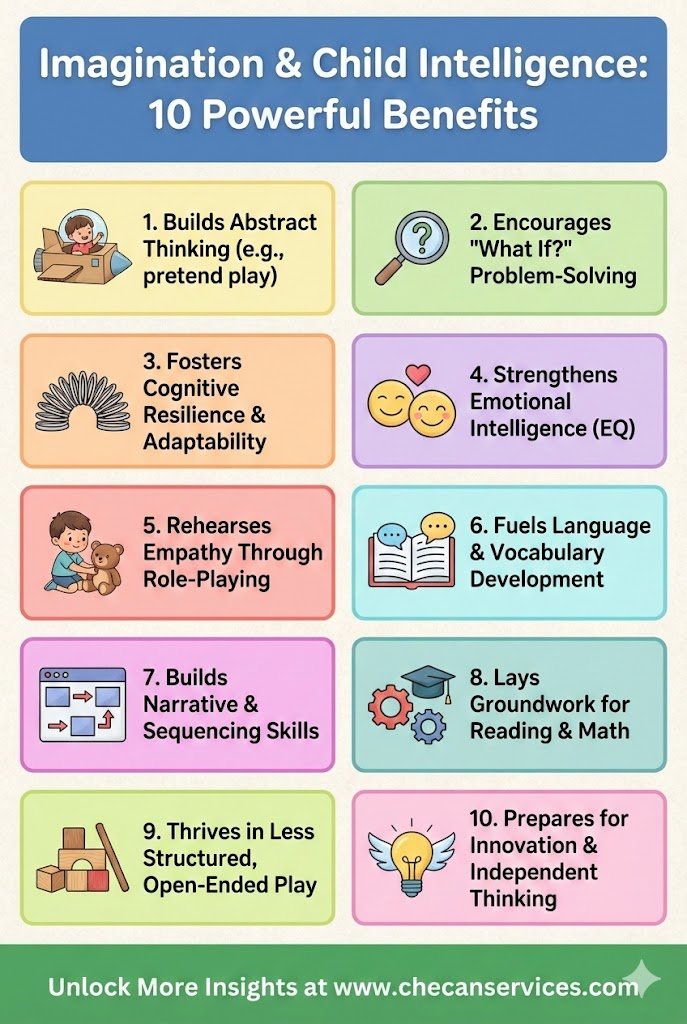
Imagination allows children to experiment safely. When a child pretends a cardboard box is a spaceship or a blanket is a castle wall, their brain is practicing abstract thinking. They’re learning how one thing can represent another, a skill that later supports reading comprehension, math concepts, and problem-solving.
This kind of mental flexibility is at the heart of intelligence. Imaginative play encourages children to ask “what if?” questions, helping them explore possibilities rather than memorizing fixed answers. Over time, this habit builds cognitive resilience—the ability to approach challenges creatively instead of shutting down when something feels unfamiliar.
Emotional Intelligence Grows Through Make-Believe
Imagination doesn’t just shape thinking skills; it also strengthens emotional intelligence. When children act out roles like teacher, doctor, parent, or even a misunderstood dragon, they step into perspectives beyond their own. This role-playing helps them understand emotions, intentions, and social cues.
For example, a child pretending to comfort a stuffed animal is rehearsing empathy. These early imaginative experiences lay the groundwork for communication skills, cooperation, and emotional regulation—abilities that are just as critical to intelligence as logic or memory.
Language, Storytelling, and Cognitive Growth
Imaginative play naturally fuels language development. Children narrate their games, invent characters, and build stories with beginnings, conflicts, and resolutions. This storytelling strengthens vocabulary, sentence structure, and narrative thinking.
As children create and revise their imaginary worlds, they’re also practicing sequencing and cause-and-effect reasoning. These skills directly support academic learning later on, especially in reading comprehension, writing, and even scientific thinking.
Why Less Structure Can Mean More Learning
Highly structured activities have their place, but imagination thrives in open-ended environments. When children are given time, space, and simple materials, their brains do the heavy lifting. A stick can become a wand, a sword, or a microphone—each transformation stretching creative and intellectual capacity.
In a future shaped by rapid change and complex problems, the ability to imagine solutions will matter more than memorizing facts. Children who grow up exercising their imagination are often better prepared to innovate, adapt, and think independently as adults.
Key Takeaways for Parents and Caregivers
Imagination is not a distraction from learning—it is learning. Encouraging pretend play, storytelling, and creative exploration helps children develop intellectual, emotional, and social intelligence together. By valuing imagination today, we help children build the mental tools they’ll rely on for a lifetime.
If you’re interested in stories and ideas that celebrate curiosity, creativity, and inner growth, explore the inspiring ebooks by Louise Blount on Apple Books. You can discover them all here and find gentle, imaginative reads that nurture young minds and thoughtful adults alike.