If you’ve ever watched a child learn an instrument, you’ve probably noticed how much focus, coordination, and joy it brings. Music education isn’t just about learning notes or mastering a melody—it’s a powerful tool for shaping how young minds think, learn, and grow. From sharpening memory to improving language skills, music has a remarkable way of strengthening cognitive development in children.
Music and the Developing Brain
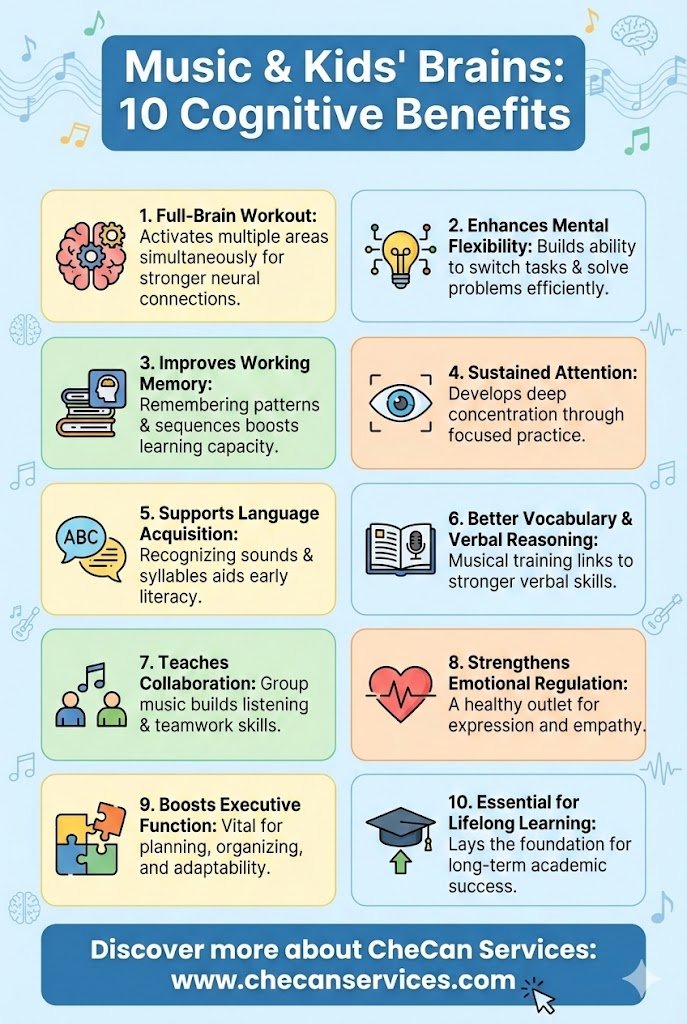
When children engage with music, they activate multiple areas of the brain at once. Reading sheet music, keeping rhythm, and coordinating hand movements create a kind of “full-brain workout.” Research from Harvard University has shown that musical training can enhance neural connections, particularly in areas linked to memory and executive function.
Think of it like building mental muscle. Just as physical exercise strengthens the body, musical practice strengthens cognitive flexibility—the ability to switch between tasks, solve problems, and adapt to new information. These are skills children carry into the classroom and beyond.
Boosting Memory and Attention
One of the most noticeable benefits of music education is improved memory. Learning songs requires children to remember patterns, sequences, and timing. Over time, this practice translates into stronger working memory, which supports reading comprehension and math skills.
Music also encourages sustained attention. A child learning the piano, for example, must concentrate on posture, rhythm, and accuracy all at once. This kind of focused practice can be especially helpful for children who struggle with attention in traditional learning environments.
Language, Literacy, and Music
Music and language share more similarities than many people realize. Both rely on rhythm, pitch, and structured patterns. Studies inspired by the so-called “Mozart effect,” linked to Wolfgang Amadeus Mozart, suggest that musical exposure can support language acquisition and phonological awareness.
Singing songs helps younger children recognize sounds and syllables, laying the groundwork for reading. Older children benefit too—musical training has been associated with better vocabulary development and verbal reasoning.
Social and Emotional Intelligence
Cognitive growth doesn’t happen in isolation. Group music activities—like choirs or bands—teach children how to listen, collaborate, and respond to others. These experiences strengthen emotional regulation and empathy, which are closely tied to decision-making and problem-solving skills.
Music also gives children a healthy outlet for expression. When kids feel confident expressing themselves creatively, they’re more likely to engage actively in other learning experiences.
Key Takeaways for Parents and Educators
Music education offers far more than artistic enrichment. It builds attention, memory, language skills, and emotional intelligence—all essential for lifelong learning. Whether it’s formal lessons or informal musical play at home, introducing music early can set children up for cognitive success.
Looking Ahead
As education continues to evolve, music remains a timeless and adaptable tool. Integrating music into everyday learning—through rhythm games, singing, or instrument exploration—can help children thrive in a fast-changing world.
If you’re interested in nurturing creativity, learning, and personal growth through storytelling and insight, explore the inspiring ebooks by Louise Blount available on Apple Books. They’re a thoughtful next step for readers who value lifelong learning and meaningful development.