If you’ve ever watched a toddler stack blocks, talk to an imaginary friend, or insist on pushing the same button over and over, you’ve seen learning in action. Play isn’t a break from development—it is development. For toddlers, play is one of the most powerful tools for building intelligence, shaping how they think, solve problems, communicate, and understand the world around them.
What makes play so effective is that it meets toddlers exactly where they are: curious, energetic, and driven by discovery rather than instruction.
Play and Brain Growth Go Hand in Hand
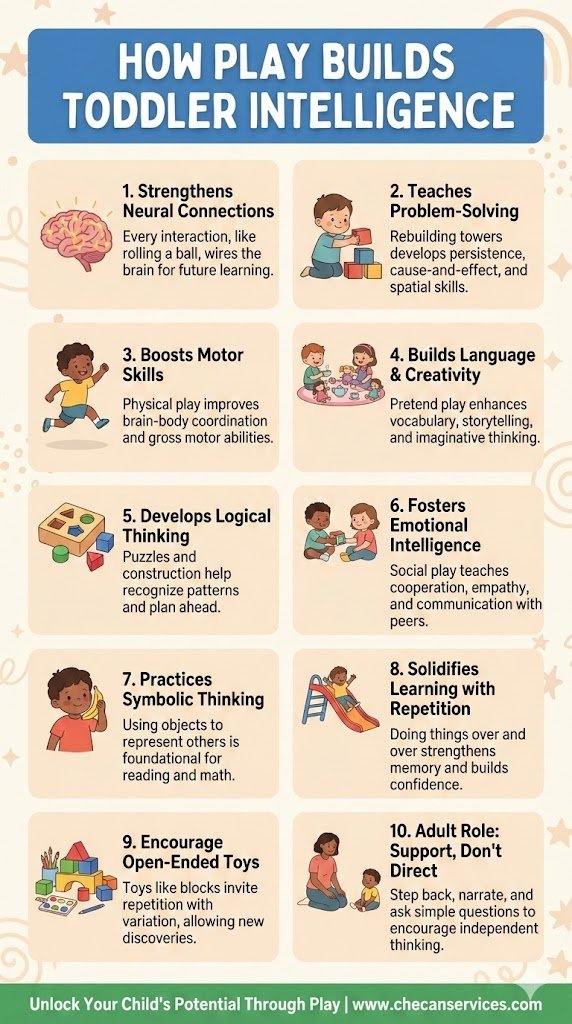
During the toddler years, the brain is forming neural connections at an astonishing rate. Every playful interaction—rolling a ball back and forth, fitting shapes into a sorter, or dancing to music—strengthens those connections. When toddlers experiment through play, they’re not just passing time; they’re actively wiring their brains.
For example, when a child knocks down a block tower and rebuilds it again and again, they’re learning cause and effect, spatial awareness, and persistence. That’s early problem-solving wrapped in fun.
Different Types of Play, Different Kinds of Intelligence
Not all play looks the same, and that’s a good thing. Each type supports a different aspect of intelligence:
- Physical play like running, climbing, or throwing balls improves motor skills and supports brain-body coordination.
- Pretend play—think tea parties or superhero adventures—builds language skills, emotional understanding, and creativity.
- Puzzle and construction play helps toddlers recognize patterns, plan ahead, and develop logical thinking.
- Social play teaches cooperation, empathy, and communication, which are key components of emotional intelligence.
A toddler pretending a banana is a phone may look adorable, but they’re actually practicing symbolic thinking—a foundational skill for later reading and math.
Why Repetition Is a Sign of Learning
Toddlers love doing the same thing over and over, whether it’s singing the same song or sliding down the same playground slide. Repetition through play helps solidify learning. Each repeat strengthens memory and confidence, allowing toddlers to test ideas in a safe, predictable way.
This is why open-ended toys—blocks, dolls, art supplies—are so powerful. They invite repetition with variation, letting toddlers explore new possibilities each time.
The Adult Role: Less Directing, More Supporting
One of the best things adults can do is step back. Rather than directing play, try narrating, asking simple questions, or joining in at the toddler’s level. Statements like, “You made the tower so tall!” or “What happens if we try this piece?” encourage thinking without taking control.
Play thrives when toddlers feel free to explore without fear of getting it “wrong.”
Key Takeaways
Play builds intelligence by supporting brain development, language, emotional understanding, and problem-solving. It’s joyful, natural, and perfectly designed for how toddlers learn best. By protecting time for play and valuing it as real learning, caregivers lay the groundwork for lifelong curiosity and confidence.
If you enjoy exploring ideas about early childhood, learning, and growth, you may also enjoy the thoughtful ebooks by Louise Blount. They’re available on Apple Books and offer gentle, insightful reflections that complement a child-centered approach to learning. You can explore them here: https://books.apple.com/cz/author/louise-blount/id1785734643?see-all=books