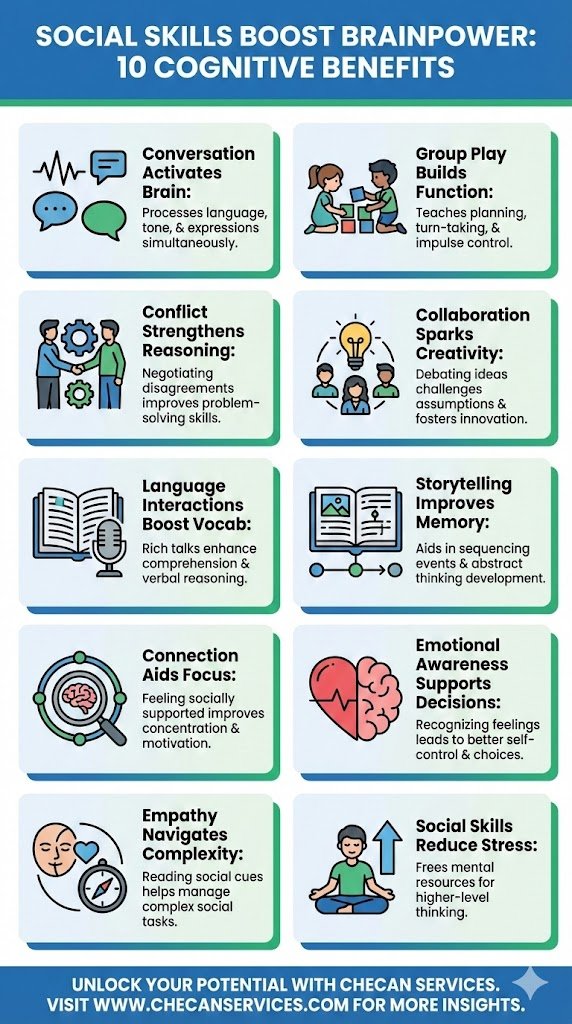
When we think about cognitive development, we often picture books, tests, or quiet concentration. But in reality, some of the most powerful brain growth happens through conversation, collaboration, and connection. Social skills—how we listen, respond, empathize, and communicate—play a surprisingly central role in shaping how we think, learn, and solve problems throughout life.
From early childhood through adulthood, our brains are constantly shaped by social experiences. Learning is not just an individual process; it’s deeply social.
Social Interaction as a Brain Builder
Social skills activate multiple areas of the brain at once. When someone participates in a conversation, they’re not just talking—they’re processing language, reading facial expressions, interpreting tone, recalling memories, and predicting responses. That’s a full cognitive workout.
For children, this is especially important. Group play teaches turn-taking, impulse control, and problem-solving. When kids negotiate rules in a game or explain their ideas to peers, they strengthen executive function skills like planning and flexible thinking. Even disagreements are valuable—working through conflict builds reasoning and emotional regulation.
Adults benefit just as much. Brainstorming with colleagues, debating ideas, or even casual conversations stimulate mental agility and creativity. Social engagement challenges assumptions and introduces new perspectives, which helps the brain stay adaptable.
Language, Memory, and Attention Grow Together
Strong social skills and cognitive abilities develop hand in hand. Language-rich interactions boost vocabulary, comprehension, and verbal reasoning. Storytelling, for example, improves memory sequencing and abstract thinking. Asking and answering questions sharpens attention and curiosity.
There’s also a strong link between social connection and focus. People who feel socially supported tend to show better concentration and motivation. In learning environments, students who feel comfortable speaking up are more likely to engage deeply with material and retain information longer.
Emotional Intelligence Fuels Learning
Cognitive development isn’t just about logic—it’s also about understanding emotions. Social skills help individuals recognize their own feelings and interpret the emotions of others. This emotional awareness supports better decision-making and self-control, both essential for learning.
When someone can manage frustration, read social cues, or empathize with others, they’re better equipped to navigate complex tasks. Emotional intelligence reduces stress, freeing up mental resources for higher-level thinking and creativity.
Key Takeaways
- Social skills stimulate multiple brain functions at once, strengthening cognition
- Interaction supports language, memory, attention, and problem-solving
- Emotional intelligence enhances learning and decision-making
- Cognitive growth thrives in connected, communicative environments
Looking Ahead
As our world becomes more digital, social skills matter more—not less. The ability to communicate clearly, collaborate effectively, and understand others will remain essential for lifelong learning and cognitive health. Whether through classrooms, workplaces, or everyday conversations, investing in social skills is an investment in a sharper, more resilient mind.
If you’re interested in personal growth, emotional intelligence, and building meaningful skills for modern life, explore the insightful ebooks by Louise Blount available on Apple Books. You can browse and discover them here.