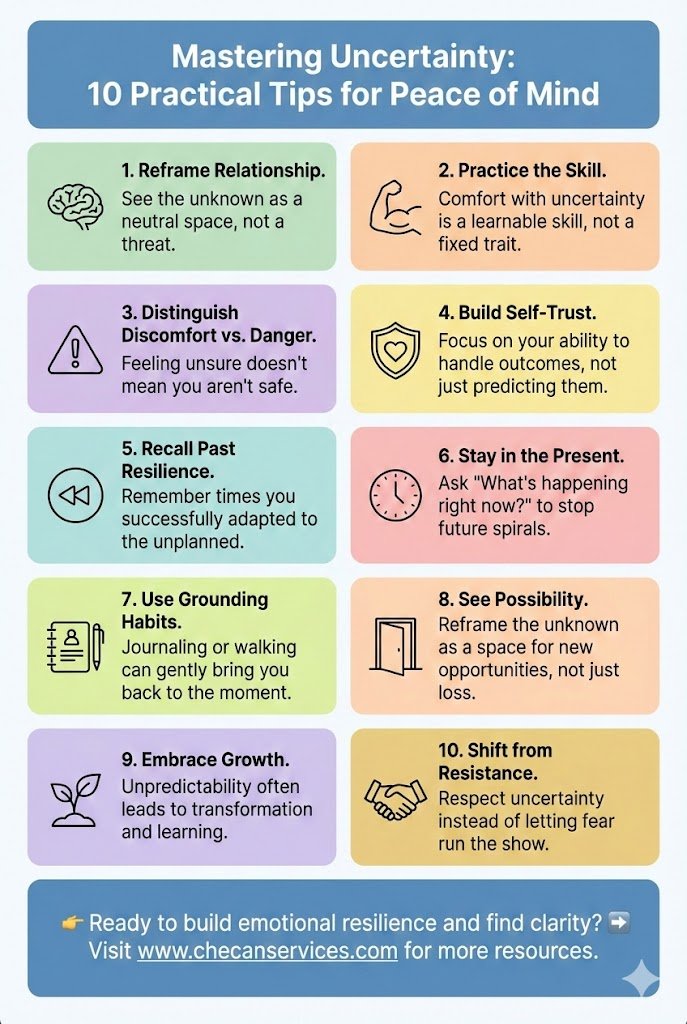
Uncertainty is one of those things we all experience, yet most of us spend a lot of energy trying to avoid it. We plan, predict, analyze, and rehearse every possible outcome—only to discover that life rarely follows the script. Learning to be comfortable with uncertainty isn’t about giving up control entirely; it’s about changing how you relate to the unknown.
In today’s fast-moving world, uncertainty shows up everywhere. Careers evolve, relationships shift, technology changes how we live and work, and global events can alter plans overnight. If certainty were a requirement for peace of mind, most of us would never feel calm. The good news is that comfort with uncertainty is a skill, not a personality trait, and it can be learned with practice.
One of the biggest reasons uncertainty feels uncomfortable is because our brains are wired to seek safety. The unknown can register as a threat, even when there’s no real danger. For example, waiting to hear back after a job interview can feel unbearable—not because something bad has happened, but because you don’t yet know what will happen. Recognizing that discomfort doesn’t equal danger is a powerful first step.
Another helpful shift is moving from “needing answers” to “building trust.” When you trust yourself to handle whatever comes next, uncertainty loses some of its power. Think about times in your life when things didn’t go as planned, yet you adapted anyway. Those moments are proof that you’re more capable than your anxious thoughts suggest.
Practical habits can also make uncertainty easier to live with. Staying present, for instance, keeps your mind from spiraling too far into imagined futures. Instead of asking, “What if everything goes wrong?” try asking, “What’s actually happening right now?” Journaling, mindfulness, or even a short walk can gently bring your attention back to the moment.
It also helps to reframe uncertainty as possibility rather than loss of control. Many of the best opportunities—new friendships, creative breakthroughs, personal growth—exist precisely because outcomes aren’t guaranteed. If everything were predictable, there would be little room for surprise, learning, or transformation.
Key Takeaways
- Uncertainty is a normal part of life, not a personal failure
- Discomfort with the unknown doesn’t mean something bad will happen
- Trusting your ability to adapt reduces anxiety
- Staying present prevents mental spirals
- Uncertainty often creates space for growth and opportunity
Looking Ahead
As life continues to change at an accelerating pace, learning to sit with uncertainty becomes less optional and more essential. The goal isn’t to eliminate fear completely, but to stop letting it run the show. Over time, uncertainty can shift from something you resist into something you respect—and sometimes even welcome.
If you’re interested in exploring personal growth, emotional resilience, and self-discovery more deeply, you may enjoy the ebooks available on Apple Books by Louise Blount. You can explore them through this collection of insightful reads and find stories and reflections that gently guide you through life’s uncertain moments.