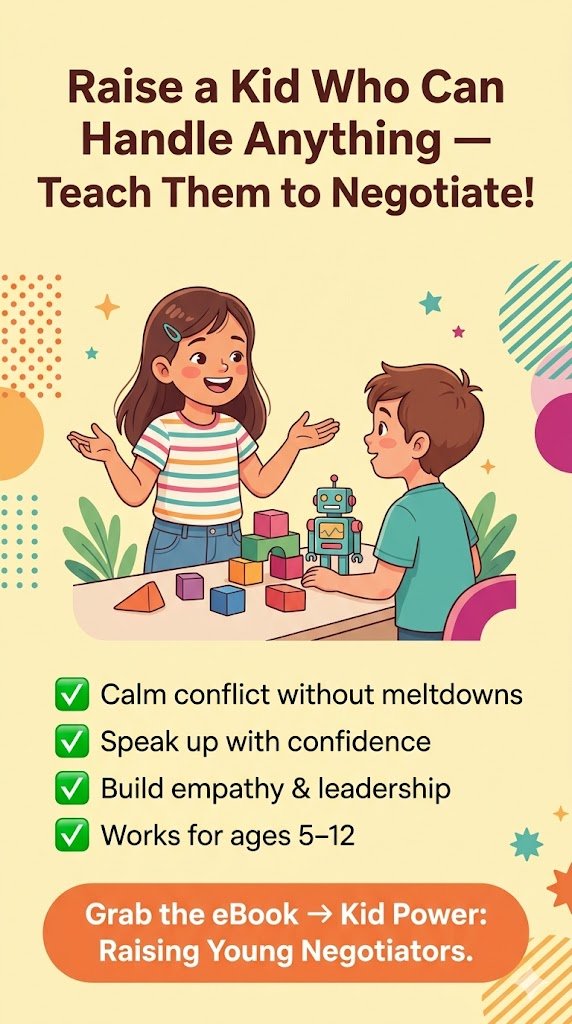
Teaching Kids the Art of Getting What They Need
Every parent has been there. Your child wants something, you say no, and within seconds the situation spirals into tears, tantrums, or sulking. But what if instead of a meltdown, your child responded with a calm, reasoned argument? What if they could advocate for themselves, listen to your side, and work toward a solution that felt fair to everyone?
That’s not a fantasy — it’s a skill. And like reading or riding a bike, negotiation can be taught.
Kid Power: Raising Young Negotiators is a practical guide for parents and educators who want to give children ages 5 to 12 one of the most valuable tools they’ll ever use: the ability to communicate clearly, solve problems with empathy, and handle disagreement with confidence.
Why Negotiation Skills Matter More Than You Think
Most people associate negotiation with boardrooms and business deals. But negotiation is happening all around your child, every single day — who gets the TV remote, how to split a snack, whether bedtime can be pushed back by fifteen minutes.
When kids lack the language and tools to navigate these moments, frustration takes over. When they have them, something remarkable happens: they start to feel capable, heard, and respected.
Research in child development consistently shows that children who can express their needs clearly and listen actively to others tend to do better socially, perform stronger academically, and grow into more confident adults. Negotiation isn’t just a life skill — it’s a foundation for emotional intelligence.
Start With the Basics: What Negotiation Actually Looks Like for Kids
Negotiation for a seven-year-old doesn’t look like a contract discussion. It looks like a child saying, “I understand we need to leave soon, but can I have five more minutes to finish this game? I’ll put my shoes on right after.”
That’s it. That’s negotiation.
It involves:
- Stating a need clearly without whining or demanding
- Acknowledging the other person’s position
- Offering a solution that works for both sides
The beautiful thing is that even young children can learn this three-step pattern when it’s modeled consistently and practiced in low-stakes situations.
How to Practice Negotiation at Home
The home is the best training ground because the stakes are real but the consequences are safe. Here are a few practical ways to build the habit:
Use everyday choices as practice rounds. Dinner menus, weekend plans, chore schedules — involve your child in these conversations. Let them make a case for what they want and gently guide them when their approach gets pushy or dismissive.
Try role-playing scenarios. Pick a situation — asking a friend to share a toy, disagreeing with a teacher about a grade, resolving a conflict with a sibling — and act it out together. Role-playing builds muscle memory for real moments.
Teach the “I hear you, and…” framework. This simple language tool helps children validate the other person’s perspective before pushing their own. It’s disarming, respectful, and remarkably effective even for adults.
Celebrate effort, not just outcomes. When your child handles a disagreement calmly — even if they don’t get what they wanted — acknowledge it. That’s the real win.
Negotiation at School: Building Leadership From the Inside Out
Classrooms are social ecosystems, and children who can communicate assertively (not aggressively) stand out. They’re the ones who can mediate a dispute between friends, speak up when something feels unfair, and collaborate effectively on group projects.
Teachers often describe these children as “natural leaders,” but leadership is rarely natural — it’s practiced. When kids learn to negotiate at home, they carry those skills into school hallways, sports teams, and eventually, workplaces.
Encouraging your child to participate in class discussions, school councils, or even friendly debates at home builds the same core muscles: listening, reasoning, proposing, and compromising.
Raising Resilient Kids, One Conversation at a Time
Perhaps the most powerful outcome of teaching negotiation is what it does for a child’s sense of self. When children learn that their voice matters — that they can advocate for themselves without losing a relationship — they develop something money can’t buy: resilience.
They learn that disagreement doesn’t mean disaster. That “no” is a starting point, not a full stop. That problems can be solved when both sides are willing to talk.
If you’re ready to raise a child who communicates with confidence, handles conflict with grace, and grows into a thoughtful, empathetic person, Kid Power: Raising Young Negotiators is the guide you’ve been looking for. It’s practical, warm, and packed with tools you can start using today.