Teaching focus and attention to preschoolers can feel like trying to catch bubbles in the wind—just when you think you’ve got one, it floats away. The good news is that attention is a skill, not a personality trait. With the right approach, young children can absolutely learn how to focus, stay engaged, and gradually build the foundation for lifelong learning.
Why Focus Looks Different in Preschoolers
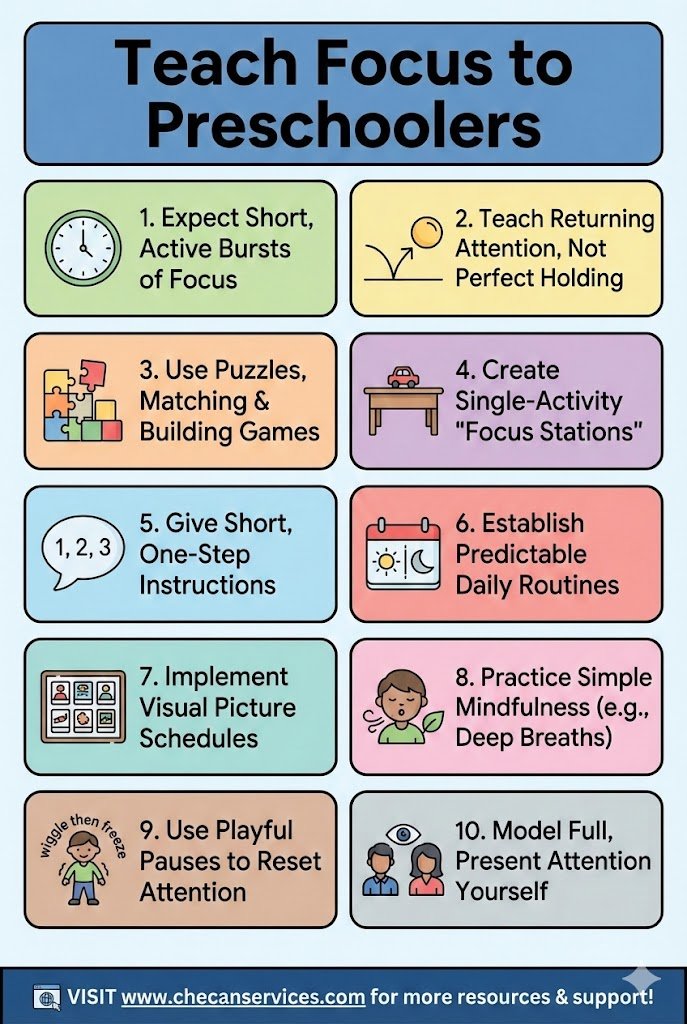
Preschoolers aren’t wired for long periods of concentration, and that’s completely normal. At ages three to five, attention spans are short, curiosity is high, and movement is essential. Expecting quiet, sustained focus for long stretches can backfire. Instead, the goal is to teach children how to return their attention, not to hold it perfectly.
This mindset shift makes all the difference.
Build Focus Through Play-Based Activities
Play is one of the most powerful tools for teaching focus. Simple activities like puzzles, matching games, or building blocks encourage children to concentrate without pressure. For example, when a child is stacking blocks, they’re practicing attention, patience, and problem-solving—all disguised as fun.
Try setting up “focus stations” with one activity at a time. Rotating materials every few days keeps interest high while encouraging children to fully engage with what’s in front of them.
Use Short, Clear Instructions
Preschoolers process information best in small pieces. Instead of saying, “Clean up the toys, wash your hands, and come sit on the carpet,” break it down:
- “Let’s put the toys away.”
- “Now it’s time to wash hands.”
- “Great—come sit with me.”
This reduces mental overload and helps children practice focusing on one task at a time. Over time, they’ll become more capable of handling multi-step directions.
Create Predictable Routines
Routines quietly teach attention by reducing uncertainty. When children know what’s coming next, they don’t waste mental energy guessing. A predictable flow—circle time, snack, play, story—creates a sense of safety that supports focus.
Visual schedules with pictures are especially effective. They allow children to “see” their day and mentally prepare for transitions.
Teach Calm as a Skill
Focus and calm go hand in hand. Introducing simple mindfulness practices—like taking three deep breaths, listening for a bell sound, or doing a quick body stretch—can help preschoolers reset their attention.
For example, before storytime, invite children to “wiggle their fingers, then freeze.” This playful pause helps their bodies and minds settle, making it easier to listen.
Model the Attention You Want to See
Children learn focus by watching adults. When you sit with them, make eye contact, and give your full attention—even for a few minutes—you’re showing them what focus looks like. Put the phone away, slow down your speech, and be present. These small moments have a big impact.
Key Takeaways for Teaching Focus Early
Teaching focus to preschoolers isn’t about control—it’s about guidance. By using play, routines, clear communication, and calm moments, you help children develop attention skills that will support them well beyond the preschool years. As these habits grow, so does their confidence, independence, and love of learning.
If you’re looking for gentle, story-based resources that support emotional growth, attention, and early learning, explore the ebooks by Louise Blount on Apple Books. You can discover them here: https://books.apple.com/cz/author/louise-blount/id1785734643?see-all=books