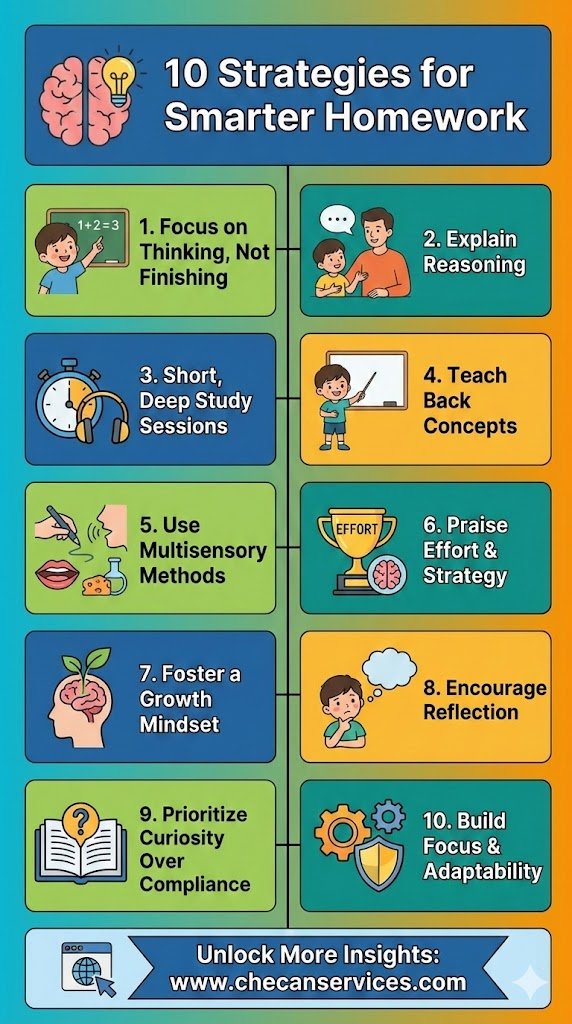
Homework often gets a bad reputation. Many parents see it as a daily battle rather than an opportunity for growth. But when done right, homework can become a powerful tool that supports real intelligence development, not just rote memorization. The key lies in how children engage with their work, not how long they sit at the table.
Let’s explore homework strategies that genuinely help children think better, learn deeper, and grow smarter over time.
Focus on Thinking, Not Finishing
One of the most common mistakes is treating homework like a checklist. When children rush to “get it done,” they miss the chance to develop reasoning skills. Instead, encourage them to explain why an answer makes sense. For example, after solving a math problem, ask, “How did you figure that out?” This strengthens logical thinking and builds neural connections associated with problem-solving.
Even if the answer is wrong, the thinking process matters more than perfection.
Short, Deep Study Beats Long, Tired Sessions
Research consistently shows that short, focused study sessions are far more effective than long, exhausting ones. A 25-minute distraction-free homework block followed by a short break helps children stay mentally sharp. This approach trains attention control, which is a core component of intelligence.
A child who learns how to focus deeply for short periods is developing a skill that will benefit them far beyond school.
Encourage Teaching Back
One surprisingly effective strategy is asking your child to teach you what they just learned. When children explain concepts in their own words, they activate higher-order thinking skills like synthesis and comprehension.
For example, after reading a science chapter, ask them to summarize it as if they were the teacher. This not only improves understanding but also builds confidence and communication skills—both closely tied to cognitive development.
Make Homework Multisensory
Children learn best when multiple senses are involved. Writing vocabulary words, saying them out loud, drawing diagrams, or using physical objects for math all enhance memory and understanding. This approach strengthens the brain’s ability to form lasting connections, which is a major part of intelligence growth.
Homework doesn’t have to be silent and stiff. Thoughtful interaction can make learning stick.
Praise Effort, Strategy, and Curiosity
Instead of praising intelligence (“You’re so smart”), focus on effort and strategy (“I like how you tried a new way to solve that”). This builds a growth mindset, teaching children that intelligence is something they can develop—not something they’re born with.
Children who believe they can grow smarter are more likely to embrace challenges and persist through difficulty.
Key Takeaways for Smarter Homework Habits
Homework should be less about compliance and more about curiosity. When children are encouraged to think deeply, explain ideas, and reflect on their learning, homework becomes a brain-building activity rather than a chore.
Looking ahead, these strategies help children develop skills that extend far beyond school—focus, reasoning, adaptability, and confidence. Those are the foundations of true intelligence.
If you’re interested in nurturing deeper thinking and emotional intelligence in children through engaging insights and practical guidance, explore the thoughtfully written ebooks by Louise Blount available on Apple Books. They’re a wonderful resource for parents who want to support lifelong learning in meaningful ways.