You had a great call. They seemed interested. They asked smart questions. You sent the proposal.
And then… silence.
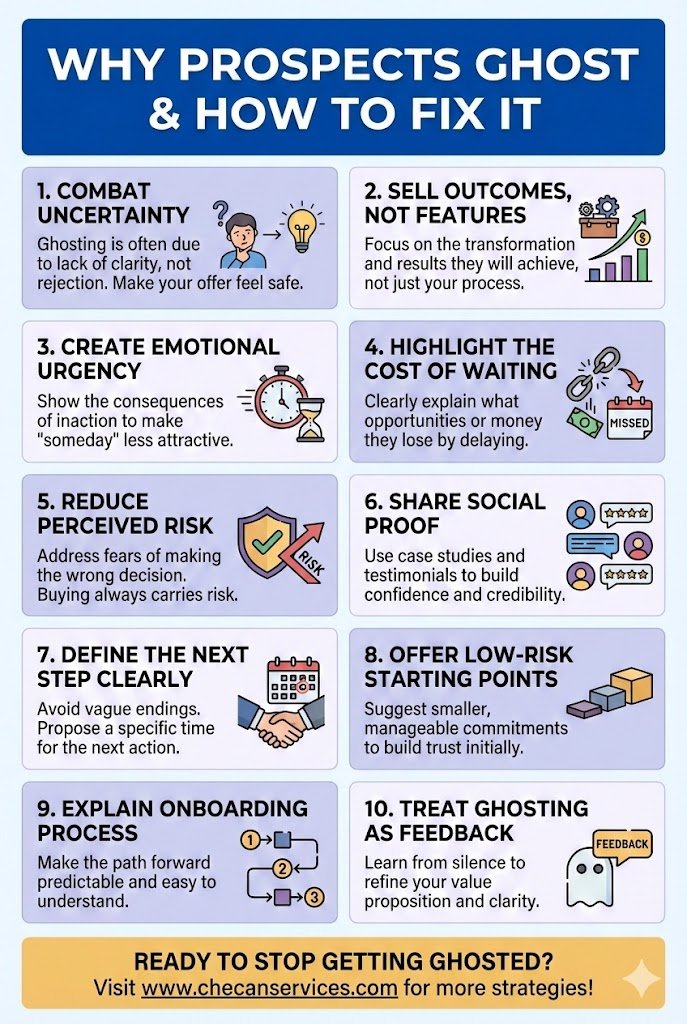
If you’ve ever wondered why prospects suddenly disappear, you’re not alone. Ghosting has become one of the most frustrating parts of sales, freelancing, and business development. But here’s the truth: most prospects don’t ghost because they’re rude. They ghost because something didn’t feel safe, urgent, or clear enough to move forward.
Let’s break down what’s really happening—and what you can do differently.
It’s Not Rejection. It’s Uncertainty.
When a prospect goes quiet, it’s rarely a dramatic “no.” It’s usually a quiet “I’m not sure.”
Uncertainty creates inaction.
If your offer feels even slightly unclear, risky, or complicated, the brain defaults to delay. And delay often turns into disappearance.
Think about your own behavior. Have you ever ignored a sales email because deciding felt like work? That’s exactly what your prospect is experiencing.
The issue isn’t that they dislike you. It’s that they don’t feel confident enough to commit.
You Sold Features, Not Outcomes
Many professionals explain what they do instead of what changes.
For example:
- “I build websites.”
- “I offer coaching sessions.”
- “I provide marketing strategy.”
That sounds fine on the surface. But it doesn’t answer the real question in your prospect’s mind:
“What happens for me if I say yes?”
People don’t buy services. They buy results. They buy relief. They buy growth. They buy transformation.
If your conversation focused more on your process than their future, they may have walked away unconvinced.
You Didn’t Create Emotional Urgency
Another hidden reason prospects ghost you? There was no compelling reason to act now.
If everything sounds optional, your offer becomes “someday.”
And “someday” is the graveyard of closed deals.
This doesn’t mean you need fake scarcity or pressure tactics. It means you need clarity around consequences.
What happens if they wait six months?
What opportunities will they miss?
What problem will continue costing them money, time, or energy?
When prospects clearly see the cost of inaction, silence becomes less attractive.
They’re Afraid of Making the Wrong Decision
Buying always carries risk.
Even if your service is perfect, they may worry about:
- Looking foolish to their team
- Wasting budget
- Choosing the wrong provider
- Failing to implement properly
If you didn’t actively reduce perceived risk, ghosting becomes their safest option.
You can fix this by:
- Sharing specific case studies
- Explaining your onboarding process clearly
- Setting expectations about timelines
- Offering small, low-risk starting points
The more predictable the experience feels, the less likely they are to disappear.
You Left the Next Step Vague
Here’s a practical but often overlooked reason: you didn’t clearly define what happens next.
Ending a call with, “Let me know what you think,” sounds polite. But it transfers all momentum to them.
Instead, try:
- “I’ll send the proposal today. Can we review it together Thursday at 2?”
- “If this looks good, we’ll start onboarding next Monday.”
- “What would need to happen for you to feel comfortable moving forward?”
Clarity reduces friction. Friction causes ghosting.
The Deeper Truth: Ghosting Is a Signal
Instead of seeing ghosting as personal rejection, treat it as feedback.
It’s telling you:
- Your value wasn’t concrete enough
- The urgency wasn’t strong enough
- The risk wasn’t lowered enough
- The next step wasn’t clear enough
When you adjust those four areas, ghosting dramatically decreases.
You won’t eliminate it completely—some prospects simply aren’t ready—but you’ll notice more decisive responses. Even a clear “no” is better than silence.
What This Means for Your Future Sales
The future of successful selling isn’t about being more persuasive. It’s about being more clarifying.
When prospects deeply understand:
- The outcome
- The timeline
- The risk level
- The next step
They don’t ghost. They decide.
And decisions move businesses forward.
If you want to sharpen your communication, build stronger positioning, and create offers people feel confident saying yes to, expanding how you think about persuasion and human behavior makes a difference. You can explore deeper insights in Louise Blount’s books for practical strategies that help you turn uncertainty into action.