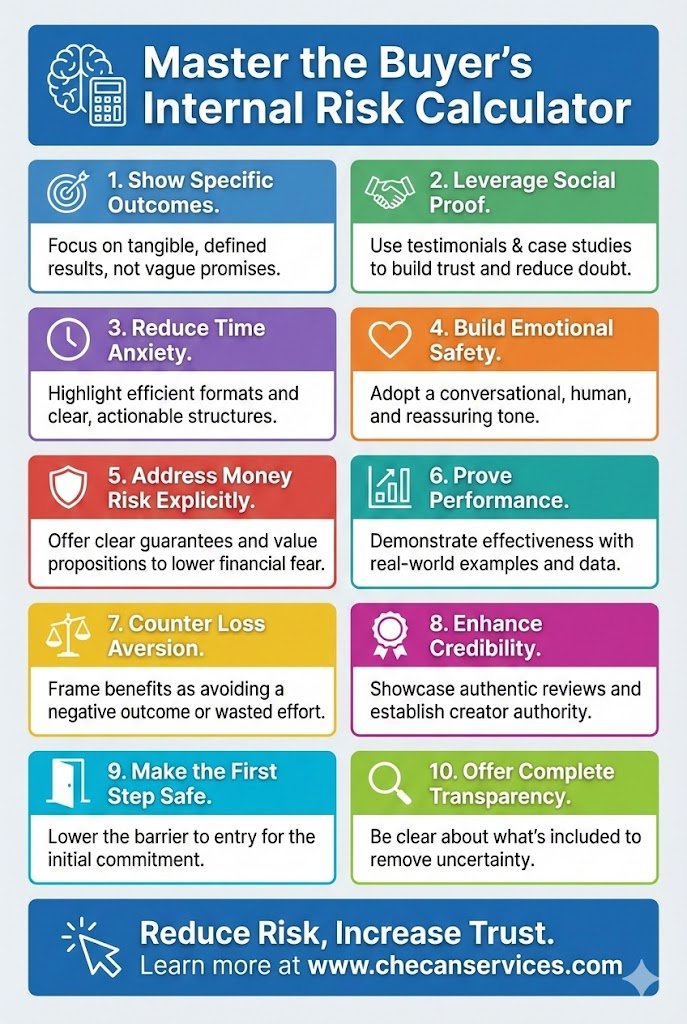
Every time someone considers buying something — a book, a course, a software subscription, even a $5 coffee — there’s a silent calculation happening in their mind.
It’s not written down. It’s not logical in a spreadsheet way. But it’s powerful.
This is what we can call the buyer’s internal risk calculator.
Understanding it can completely change how you sell, market, or even present ideas. Because people don’t just buy based on value. They buy based on perceived risk.
Let’s break down how it works — and why it matters more than ever in the future of digital business.
What Is the Internal Risk Calculator?
The internal risk calculator is the mental equation every buyer runs before saying “yes.”
It weighs:
- Money risk – “Will I lose my money?”
- Time risk – “Will this waste my time?”
- Emotional risk – “What if I regret this?”
- Social risk – “What will others think?”
- Performance risk – “What if it doesn’t work?”
People don’t consciously list these categories. But they feel them.
Imagine someone considering buying an online writing guide. The price might be affordable. But their brain is asking:
“Will this actually help me?”
“What if it’s basic stuff I already know?”
“What if I buy it and never finish it?”
That internal hesitation isn’t about price. It’s about risk.
Why Risk Feels Bigger Than Reward
Human psychology is wired to avoid loss more than to chase gain. This is known as loss aversion, a concept introduced by psychologists Daniel Kahneman and Amos Tversky.
Their research showed something powerful:
Losing $100 hurts more than gaining $100 feels good.
That’s why a $20 ebook can feel “expensive” if uncertainty is high.
In today’s world — where buyers are flooded with options — this effect is even stronger. Every new product competes not just with other products, but with skepticism.
The Modern Buyer Is More Risk-Aware
In the past, people relied on brand names or physical stores for trust.
Today, buyers check reviews, compare alternatives, and search social proof before committing. Platforms like Amazon have trained us to scroll through ratings before clicking “Buy Now.”
Digital marketplaces have made access easier — but they’ve also raised expectations.
Now the buyer’s internal risk calculator includes new questions:
- Are there real reviews?
- Does the creator seem credible?
- Is there proof this works?
- What happens if I don’t like it?
The more invisible the seller (as in digital products), the more intense the risk calculation becomes.
How Sellers Can Lower the Risk Score
If you understand this mental process, the strategy becomes clear:
Reduce perceived risk faster than you increase perceived value.
Here’s how.
1. Show Specific Outcomes
Instead of saying, “This will improve your writing,” say:
“By the end of this guide, you’ll be able to outline, draft, and publish your first short nonfiction ebook.”
Specificity lowers uncertainty.
2. Use Social Proof
Testimonials, case studies, and real-world examples reduce performance risk.
When buyers see someone like them succeed, their calculator shifts.
“Maybe this will work for me too.”
3. Reduce Time Anxiety
Many buyers hesitate not because of money, but because of time.
Clear formats help:
- “Read in 90 minutes”
- “5-step framework”
- “Short, actionable chapters”
Structure signals efficiency.
4. Build Emotional Safety
Tone matters.
A conversational, human voice feels safer than corporate language. Buyers want reassurance, not pressure.
The future of selling — especially in ebooks, courses, and knowledge products — will favor creators who feel trustworthy, relatable, and clear.
What This Means for the Future
As AI tools, digital products, and self-publishing continue to grow, trust will become the real currency.
Buyers will increasingly choose creators who reduce uncertainty quickly.
This is especially true in personal development, writing, and creative education — where results depend partly on the reader’s own effort.
The best creators won’t just promise transformation.
They’ll make the first step feel safe.
Because when perceived risk drops below perceived reward, the decision becomes easy.
Key Takeaways
- Every buyer runs a silent risk calculation before purchasing.
- Risk feels stronger than potential gain.
- Modern buyers are more skeptical — and more informed.
- Specificity, proof, and clarity lower perceived risk.
- The future belongs to creators who build trust first.
When you understand the buyer’s internal risk calculator, you stop trying to “convince” people — and start making them feel safe.
If you’re interested in exploring ideas about clarity, creative confidence, and building something meaningful in today’s digital world, you might enjoy browsing Louise Blount’s books — practical reads designed to help thoughtful creators move forward with confidence.