Have you ever opened a streaming app and spent 20 minutes scrolling, only to give up and rewatch something familiar? Or stood in the grocery aisle comparing five nearly identical brands of olive oil? That mental exhaustion you feel isn’t random — it’s called decision fatigue, and it’s becoming one of the biggest hidden stressors of modern life.
In today’s digital world, consumers make more choices in a single day than previous generations made in a week. From what to wear and eat to which subscription service to use, every decision costs mental energy. Over time, those small decisions quietly add up.
What Is Decision Fatigue?
Decision fatigue refers to the mental depletion that happens after making too many choices. Our brains have limited cognitive resources. The more decisions we make, the harder it becomes to make good ones.
Psychologists have long studied this phenomenon, but in the age of e-commerce, social media, and endless product variations, the impact is more visible than ever.
Modern consumers face:
- Hundreds of product options online
- Constant notifications demanding attention
- Personalized ads targeting their preferences
- Social comparisons through curated social feeds
The result? Mental overload.
Why Modern Life Makes It Worse
Choice used to be limited by geography and availability. Today, we can order anything with a click. While that sounds empowering, unlimited choice can be paralyzing.
Think about online shopping. Searching for “running shoes” might return thousands of results. You filter by brand, price, rating, color, and reviews. Suddenly, what should be a simple purchase becomes a research project.
Streaming services offer another example. With so many options, choosing what to watch often feels harder than the act of watching itself. Many consumers report feeling overwhelmed instead of entertained.
Social media adds another layer. Every scroll presents micro-decisions: Do I like this? Comment? Share? Follow? Unfollow? Each tiny choice consumes a bit of mental energy.
The Hidden Costs of Too Many Choices
Decision fatigue doesn’t just make you tired. It influences behavior in subtle but powerful ways.
When mentally drained, consumers are more likely to:
- Choose the default option
- Make impulsive purchases
- Avoid decisions altogether
- Stick with familiar brands
- Regret their choices later
This is why after a long workday, you might order takeout instead of cooking — even if you planned to eat healthy. Your decision-making capacity is simply depleted.
Over time, this pattern can impact finances, health, and overall satisfaction.
How Brands Are Responding
Interestingly, businesses are starting to recognize decision fatigue as a real consumer problem.
Some companies simplify their product lines to reduce overwhelm. Others offer curated bundles or subscription models so customers don’t have to choose repeatedly. Even grocery stores place best-selling items at eye level to make decisions easier.
The future of consumer experience may revolve around simplification rather than expansion. Brands that reduce friction and make decisions easier are likely to build stronger loyalty.
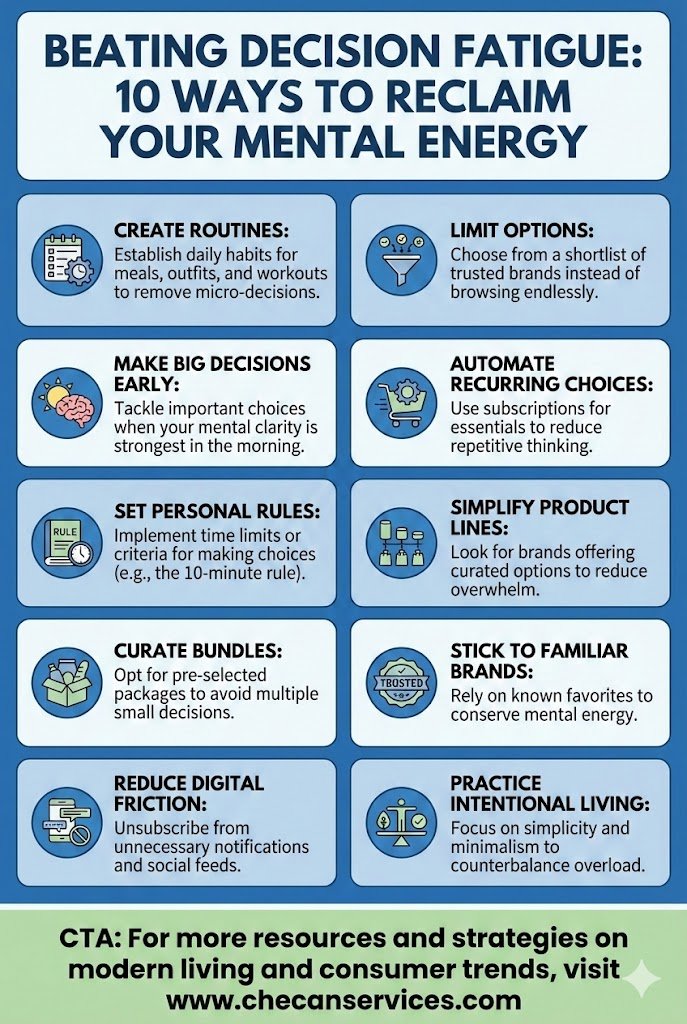
Practical Ways to Reduce Decision Fatigue
The good news? You can design your life to conserve mental energy.
Here are a few strategies that work:
1. Create routines.
Wearing similar outfits, meal planning, or scheduling workouts removes daily micro-decisions.
2. Limit options intentionally.
Instead of browsing endlessly, choose from a shortlist of trusted brands.
3. Make big decisions early in the day.
Your mental clarity is strongest in the morning.
4. Automate recurring choices.
Subscriptions for essentials like groceries or household items can reduce repetitive thinking.
5. Set personal rules.
For example: “If I can’t decide in 10 minutes, I won’t buy it.”
Small systems protect your cognitive energy for decisions that truly matter.
What This Means for the Future Consumer
As technology continues to expand, the number of available choices will only increase. Artificial intelligence may help by personalizing recommendations more accurately. However, personalization itself can become another source of subtle pressure.
The modern consumer of the future will likely value clarity over abundance. Simplicity, minimalism, and intentional living are already gaining popularity because they counterbalance decision overload.
Understanding decision fatigue gives you power. Instead of blaming yourself for “bad choices,” you can recognize when your mental energy is low and respond with compassion.
Key Takeaways
Decision fatigue is not a weakness — it’s a natural cognitive limit in an overstimulated world. By reducing unnecessary choices and building supportive routines, you can protect your energy and make more intentional decisions.
If you’re interested in exploring deeper themes around modern life, self-awareness, and personal growth, you might enjoy browsing Louise Blount’s books. Her work offers thoughtful perspectives that align beautifully with living more intentionally in a fast-paced world.