Most people believe good logic should win every time. Lay out the facts, compare the options, prove the value—and the deal should close itself. Yet in real life, even the most airtight argument often falls flat. Deals stall, buyers hesitate, and “let me think about it” becomes the final answer.
The reason is simple but uncomfortable: people don’t buy with logic first. They buy with emotion, then use logic to justify the decision afterward.
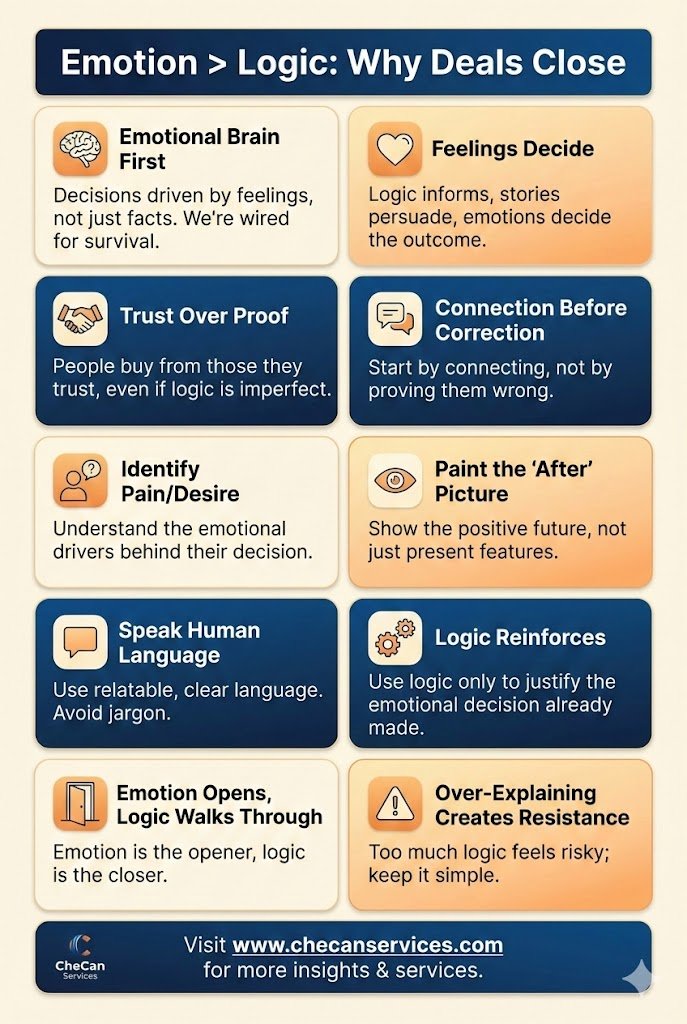
The Emotional Brain Makes the First Move
Neuroscience and behavioral psychology have shown that decisions are driven by emotion long before rational thinking gets involved. Our brains are wired for survival, not spreadsheets. When faced with a choice, we instinctively ask emotional questions: Does this feel safe? Does this align with who I am? Will I regret this?
Researchers like Daniel Kahneman describe this as fast thinking versus slow thinking. The fast, emotional system reacts instantly, while the logical system comes in later to explain why the choice “makes sense.”
In sales, marketing, and even everyday persuasion, this means logic alone is speaking to the wrong part of the brain.
Facts Inform, But Feelings Decide
Logic is not useless—it just plays a supporting role. Facts inform. Stories persuade. Emotions decide.
Think about buying a phone. You may compare battery life, camera specs, and price. But the decision often comes down to how the phone fits into your life: how it looks in your hand, how confident it makes you feel, or whether it aligns with your identity.
If logic closed deals on its own, comparison charts would replace sales conversations entirely. Instead, the most effective pitches focus on outcomes, relief, excitement, or transformation.
Trust Outweighs Proof
Another reason logic struggles to close deals is trust. People rarely say yes to someone they don’t trust—even if the argument is technically correct.
Trust is emotional. It’s built through tone, empathy, listening, and credibility. A perfectly logical proposal delivered without warmth or understanding can feel cold or manipulative.
This is why testimonials, social proof, and personal stories outperform raw data. They signal safety. They say, “Others like you have done this and survived—or even thrived.”
Over-Explaining Creates Resistance
Ironically, too much logic can push people away. When buyers feel overwhelmed with facts, they may sense pressure or uncertainty. Their emotional brain interprets this as risk.
This is why long emails, dense presentations, and excessive comparisons often delay decisions. Instead of clarity, they create friction.
Clear, confident simplicity feels safer than exhaustive explanation.
What Actually Moves a Deal Forward
To close a deal, logic must follow emotion—not lead it. The most effective communicators do a few things well:
- They identify the emotional pain or desire behind the decision
- They paint a vivid picture of life after the solution
- They speak in relatable, human language
- They use logic only to reinforce a decision already forming
When someone feels understood, logic becomes permission rather than persuasion.
What This Means for Persuasion and Communication
Whether you’re selling a product, pitching an idea, or trying to influence change, the lesson is consistent: start with connection, not correction.
Ask yourself: How does this make someone feel? What fear does it reduce? What hope does it create? Once those questions are answered, logic becomes a powerful closer instead of a weak opener.
Key Takeaways
- People decide emotionally and justify logically
- Trust and relatability matter more than perfect arguments
- Too much logic can increase hesitation
- Emotion opens the door; logic helps people walk through it
If you enjoy exploring the psychology behind decision-making, persuasion, and human behavior, you may appreciate the storytelling-driven insights found in Louise Blount’s books—a thoughtful collection that blends emotion, self-awareness, and practical reflection.