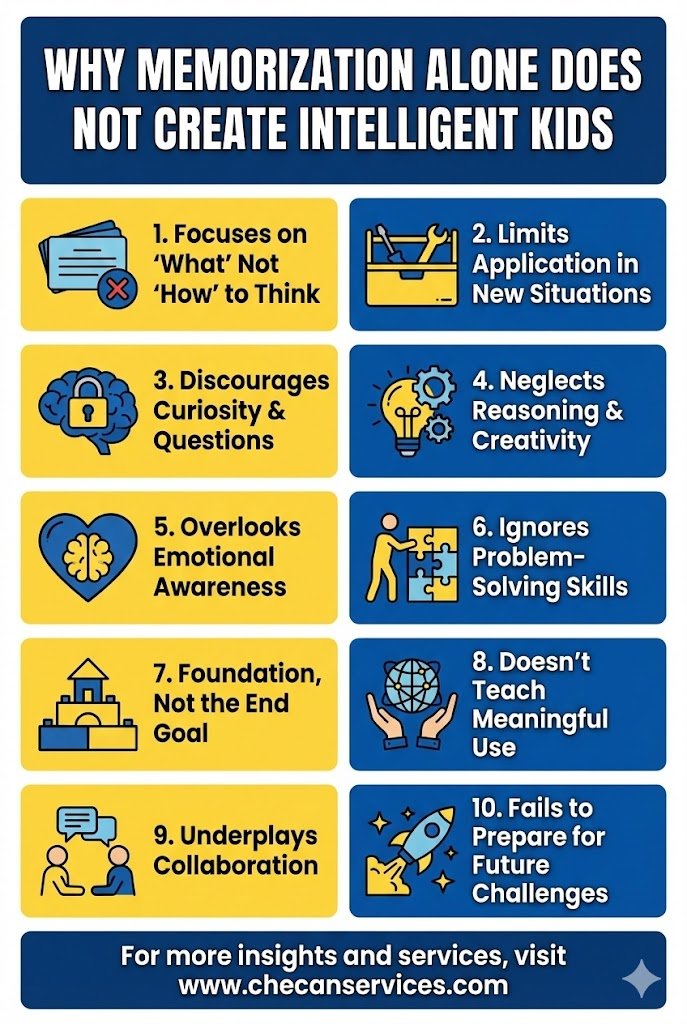
For decades, memorization has been treated as the gold standard of learning. Flashcards, rote repetition, and reciting facts have long dominated classrooms and homework routines. While memorization has its place, relying on it alone does not create intelligent kids. In fact, it can quietly limit a child’s ability to think, adapt, and thrive in a rapidly changing world.
Memorization focuses on what to think, not how to think. A child might perfectly recall multiplication tables or historical dates, but struggle to apply that knowledge in unfamiliar situations. Intelligence, especially in today’s world, is far more than recall. It’s about reasoning, creativity, emotional awareness, and the ability to solve problems when answers aren’t obvious.
Consider a simple example. A child may memorize a science definition about gravity, but when asked why a balloon floats while a rock falls, they hesitate. That pause reveals the gap between memorized knowledge and true understanding. Intelligent learning happens when children explore why things work, test ideas, make mistakes, and adjust their thinking.
Another limitation of memorization is that it often discourages curiosity. When kids are rewarded only for correct answers, they may become afraid of being wrong. Over time, this fear can silence questions and suppress imagination. Yet curiosity is one of the strongest indicators of intelligence. Kids who ask “what if?” and “how does this connect?” are building mental flexibility that memorization alone cannot offer.
That’s not to say memorization is useless. Knowing basic facts frees up mental space for deeper thinking. The problem arises when memorization becomes the end goal instead of the foundation. Intelligent kids are not those who store the most information, but those who know how to use information meaningfully.
Modern education and parenting are slowly shifting toward skills like critical thinking, collaboration, and emotional intelligence. These skills help children navigate real-life challenges—resolving conflicts, making decisions, and adapting to new technologies and careers that don’t even exist yet. A child who learns how to analyze information, question assumptions, and reflect on experiences is far better prepared for the future than one who simply memorizes answers.
Key Takeaways
- Memorization supports learning, but it does not equal intelligence.
- True intelligence involves understanding, application, and adaptability.
- Curiosity, questioning, and problem-solving build long-term cognitive strength.
- Children need safe spaces to think, explore, and even fail in order to grow.
Looking Ahead
As the world becomes more complex, intelligent kids will be those who can connect ideas, think independently, and learn continuously. Encouraging discussions at home, hands-on activities, storytelling, and reflective thinking can transform learning from mechanical repetition into meaningful growth.
If you’re interested in nurturing deeper thinking, emotional insight, and lifelong learning in children, explore the thoughtfully written ebooks by Louise Blount on Apple Books. These books offer practical, engaging perspectives that go beyond surface-level education and gently guide readers toward raising confident, capable thinkers.
👉 Discover Louise Blount’s ebooks on Apple Books