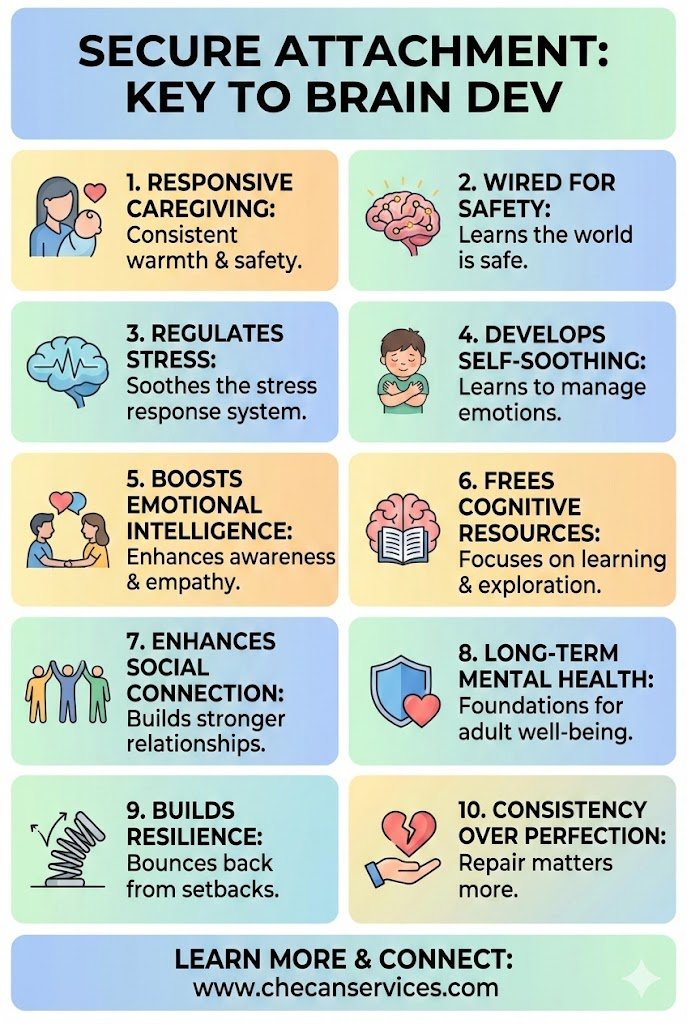
From the moment a baby is born, their brain is under rapid construction. Billions of neural connections are forming, pruning, and reorganizing at breathtaking speed. While genetics provide the blueprint, experiences provide the wiring. Among all early experiences, secure attachment stands out as one of the most powerful influences on healthy brain development.
Secure attachment isn’t about being a “perfect” parent. It’s about being a responsive one. When caregivers consistently respond to a child’s needs with warmth, safety, and predictability, the child’s brain learns a critical lesson early on: the world is safe, and I am safe in it.
How Secure Attachment Shapes the Developing Brain
In the early years, the brain develops from the bottom up. Survival systems mature first, followed by emotional regulation, and later higher-order thinking like reasoning and impulse control. Secure attachment directly supports this process.
When a baby cries and a caregiver responds calmly—by holding, soothing, or speaking gently—the child’s stress response system is regulated externally. Over time, these repeated experiences help wire the brain’s stress-regulation circuits, particularly those involving the amygdala and prefrontal cortex. The result? A child who gradually learns how to self-soothe, manage emotions, and recover from stress.
In contrast, inconsistent or unresponsive caregiving can keep a child’s stress system on high alert. This doesn’t mean occasional missteps cause harm—repair matters more than perfection. What counts is the pattern of care.
Secure Attachment and Emotional Intelligence
Children with secure attachment often show stronger emotional awareness and empathy later in life. That’s because early relational safety frees up cognitive resources. When a child doesn’t have to worry about whether their needs will be met, their brain can focus on exploration, learning, and social connection.
Think of it like this: secure attachment is the emotional equivalent of a strong Wi-Fi signal. When the connection is reliable, everything else—communication, learning, creativity—runs more smoothly.
Long-Term Benefits Beyond Childhood
Secure attachment doesn’t just shape childhood behavior; it lays the groundwork for adulthood. Research consistently links secure attachment with better mental health, healthier relationships, improved resilience, and even stronger problem-solving skills.
Adults who experienced secure attachment as children often find it easier to trust others, regulate emotions under pressure, and bounce back from setbacks. These skills are increasingly vital in a fast-changing, high-stress world.
Key Takeaways
- Secure attachment helps regulate a child’s stress response system
- It supports emotional regulation, learning, and social development
- Consistency and repair matter more than perfection
- Early relational safety has lifelong neurological benefits
Looking Ahead
As neuroscience continues to evolve, one message becomes clearer: relationships shape the brain. Investing in secure attachment early isn’t just about raising happier children—it’s about building healthier societies. When we understand how deeply connection influences development, caregiving becomes less about rules and more about presence.
If you’re interested in exploring emotional development, attachment, and inner growth more deeply, you may enjoy the insightful ebooks by Louise Blount, available on Apple Books. You can browse her collection and find a read that resonates with you here. It’s a gentle next step for anyone curious about the inner world and how early experiences shape who we become.