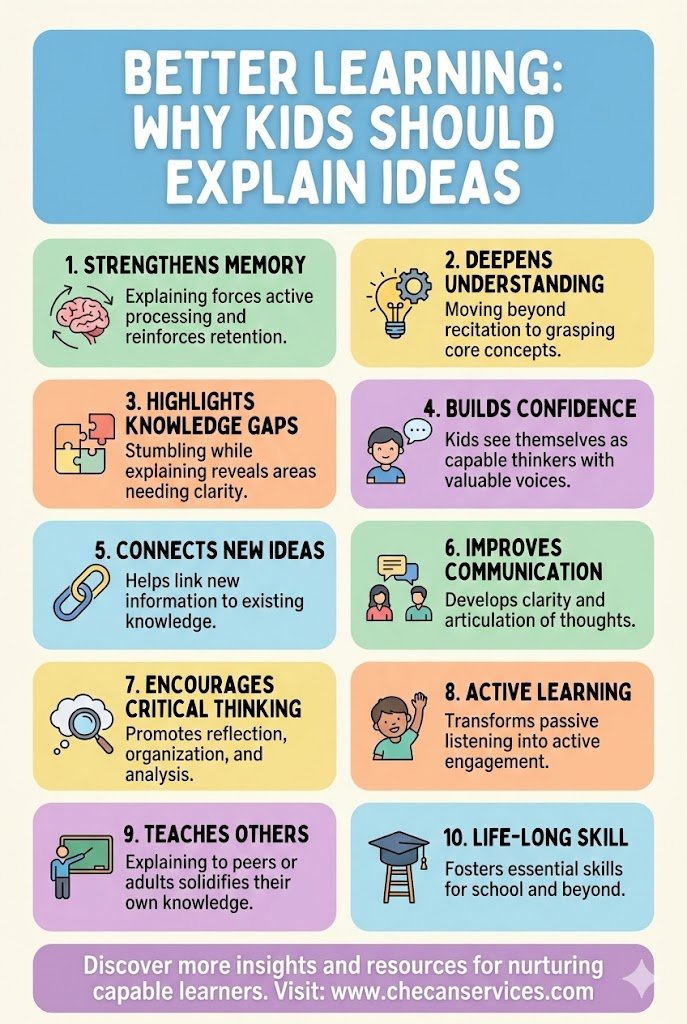
How do kids really learn best? It turns out that one of the most powerful learning tools isn’t memorization, worksheets, or even testing—it’s explanation. When children are encouraged to explain ideas in their own words, something remarkable happens: learning deepens, confidence grows, and understanding sticks.
Think about a time when a child tried to explain how a game works. They might pause, backtrack, or rephrase—but by the end, they usually understand the rules better themselves. That same principle applies to academics, from reading comprehension to math and science.
Why Explaining Ideas Changes the Way Kids Learn
When kids explain an idea, they move from passive learning to active thinking. Instead of just hearing information, they process it, organize it, and translate it into language that makes sense to them. This mental work strengthens memory and highlights gaps in understanding.
For example, a child who can recite a math formula may not fully grasp it. But ask them to explain why the formula works, and suddenly they’re engaging with the concept at a deeper level. If they stumble, it’s a clear signal—both for the child and the teacher—that more clarity is needed.
Explaining also helps children connect new information to what they already know. When kids say things like, “This is kind of like…” they’re building bridges between ideas, which is how real learning happens.
Building Confidence Through Voice and Ownership
Another powerful benefit of explanation is confidence. When children explain ideas, they begin to see themselves as capable thinkers. Their voice matters. Their understanding has value.
This is especially important for kids who may struggle academically or feel hesitant to speak up. Giving them regular opportunities to explain—whether to a peer, a parent, or a group—helps normalize thinking out loud and making mistakes along the way.
Even simple prompts like:
- “Can you explain how you got that answer?”
- “How would you teach this to someone younger?”
- “What does this mean in your own words?”
can transform how children see learning—from something done to them into something they actively shape.
Everyday Ways to Encourage Explanation
You don’t need a classroom or lesson plan to make this work. At home, ask kids to explain a story they read, teach you a new word they learned, or walk you through their reasoning when solving a problem. In classrooms, pair students up and let them teach each other concepts before formal instruction.
Over time, explaining becomes a habit. Kids learn to slow down, reflect, and think more clearly—and those skills extend far beyond school.
Key Takeaways
Teaching kids to explain ideas improves comprehension, strengthens memory, and builds confidence. It turns learning into an active, engaging process and helps children develop communication and critical thinking skills that will serve them for life.
Looking Ahead
As education continues to evolve, one thing remains constant: understanding grows when children are encouraged to think aloud. By creating environments where explanation is valued, we prepare kids not just to learn—but to understand, adapt, and thrive.
If you’re interested in thoughtful, engaging reads that explore learning, growth, and reflection, you may enjoy the ebooks by Louise Blount available on Apple Books. They’re a great companion for anyone passionate about learning—at any age.