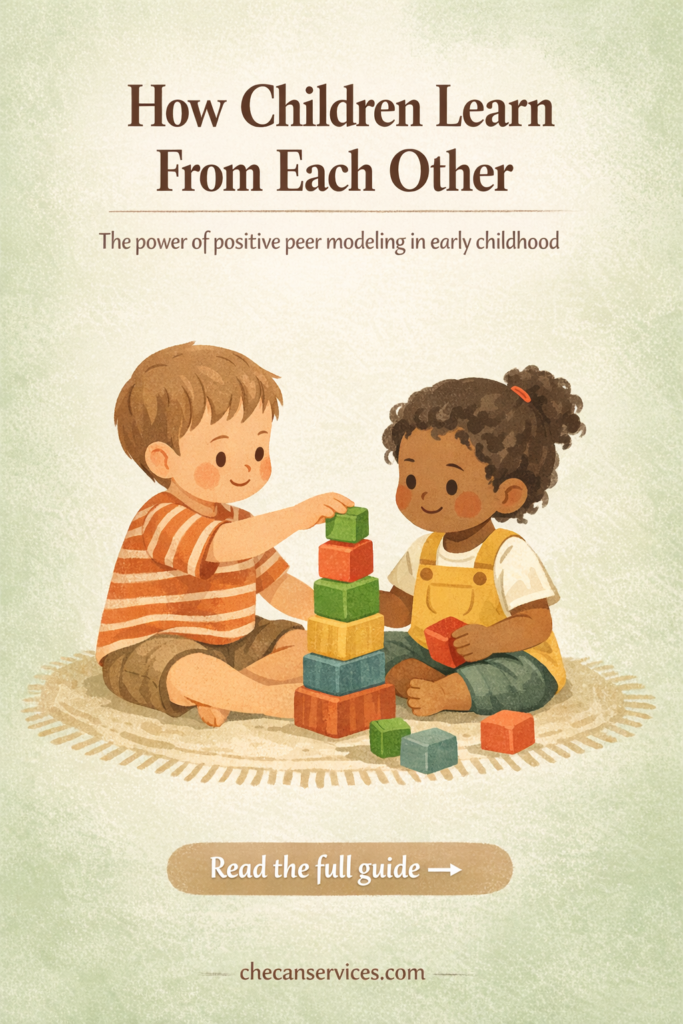
Discover how positive peer modeling shapes empathy, confidence, and social skills in early childhood.
👉 Tap to read the full guide!
#ParentingTips #ChildDevelopment #PositiveParenting #EarlyChildhood #GentleParenting #TeachingKids #ParentingSupport
Children are watching each other — constantly. Long before they fully understand words like “empathy” or “leadership,” they are quietly absorbing lessons from the children around them. A toddler mimics how a friend holds a crayon. A preschooler copies the way a classmate says “please.” A shy child slowly finds her voice after watching a peer speak up in circle time. This is peer modeling in action, and it is one of the most powerful — and most overlooked — forces in early childhood development.
Bright Influence unpacks exactly how this process works, and why paying attention to it can transform the way parents, educators, and caregivers approach everyday childhood moments.
What Is Positive Peer Modeling?
Peer modeling simply means learning by watching others. Children are natural observers, and from a very young age, they use what they see from their peers to guide their own behavior. When that influence is positive — when children witness kindness, patience, problem-solving, and cooperation — the effects ripple outward in meaningful ways.
Unlike adult instruction, peer modeling carries a special kind of credibility. When a teacher tells a child to share, it registers as a rule. When a friend shares naturally during play, it registers as something real and worth doing. That distinction matters enormously for how children internalize behavior.
How Peer Modeling Builds Empathy
One of the most encouraging findings explored in Bright Influence is how everyday peer interactions quietly build empathy — not through lessons or lectures, but through lived experience.
When a child sees a friend comfort someone who is upset, they are not just watching an action. They are absorbing an emotional script: this is what caring looks like. Over time, repeated exposure to these moments creates a foundation of emotional intelligence that follows children well beyond the early years.
This is why the environment matters so much. Children placed in spaces where kindness is modeled consistently — by peers as much as by adults — develop stronger social awareness. They become more attuned to how others feel, more likely to respond with compassion, and more capable of navigating conflict with care.
Even Quiet Children Can Lead
One of the more surprising ideas in Bright Influence is that leadership through peer modeling doesn’t belong only to the loud, outgoing child. Leadership can look like a reserved child who always waits her turn, inspiring others to do the same. It can look like the boy who quietly helps clean up without being asked, or the girl who notices when someone is left out and gently includes them.
Children who might never be described as “natural leaders” in the traditional sense are, in fact, shaping the social culture of their groups every single day. When we recognize and celebrate these quiet acts of influence, we give every child permission to see themselves as someone who matters — someone whose behavior makes a difference.
Creating Environments That Encourage Positive Modeling
Understanding peer modeling is one thing. Designing environments that cultivate it is another. Here are some practical ways to put these ideas to work:
Group children thoughtfully. Mixing ages or temperaments creates natural opportunities for modeling. Younger children benefit from watching older peers, and older children grow by being looked up to.
Name what you see. When you observe a child doing something kind or helpful, point it out — not in a way that embarrasses, but in a way that illuminates. “Did you notice how Maya waited for everyone to get a turn? That was really kind.” This makes the behavior visible and worth repeating.
Create cooperative routines. Group tasks — setting the table together, cleaning up as a team, working on a shared project — give children daily practice in watching, following, and eventually leading.
Tell stories about real moments. Children connect deeply with stories from their own world. Reflecting back a moment where a peer was helpful or brave reinforces the idea that this kind of behavior is real, valued, and worth repeating.
Small Moments, Lasting Impact
It is easy to look for big turning points in a child’s development — a milestone, a program, a curriculum. But Bright Influence reminds us that the most powerful influences are often the smallest ones. A moment of shared laughter. A spontaneous act of kindness on the playground. A child who chooses to be gentle when they could have been rough.
These moments, multiplied across days and years, are what shape character. They are what build the empathetic, socially aware individuals we hope our children will grow into.
If you want to go deeper into how to harness these everyday moments to raise kinder, more confident children, Bright Influence is a warm, practical guide worth reading — for any parent, educator, or caregiver who believes the small stuff is actually the big stuff.