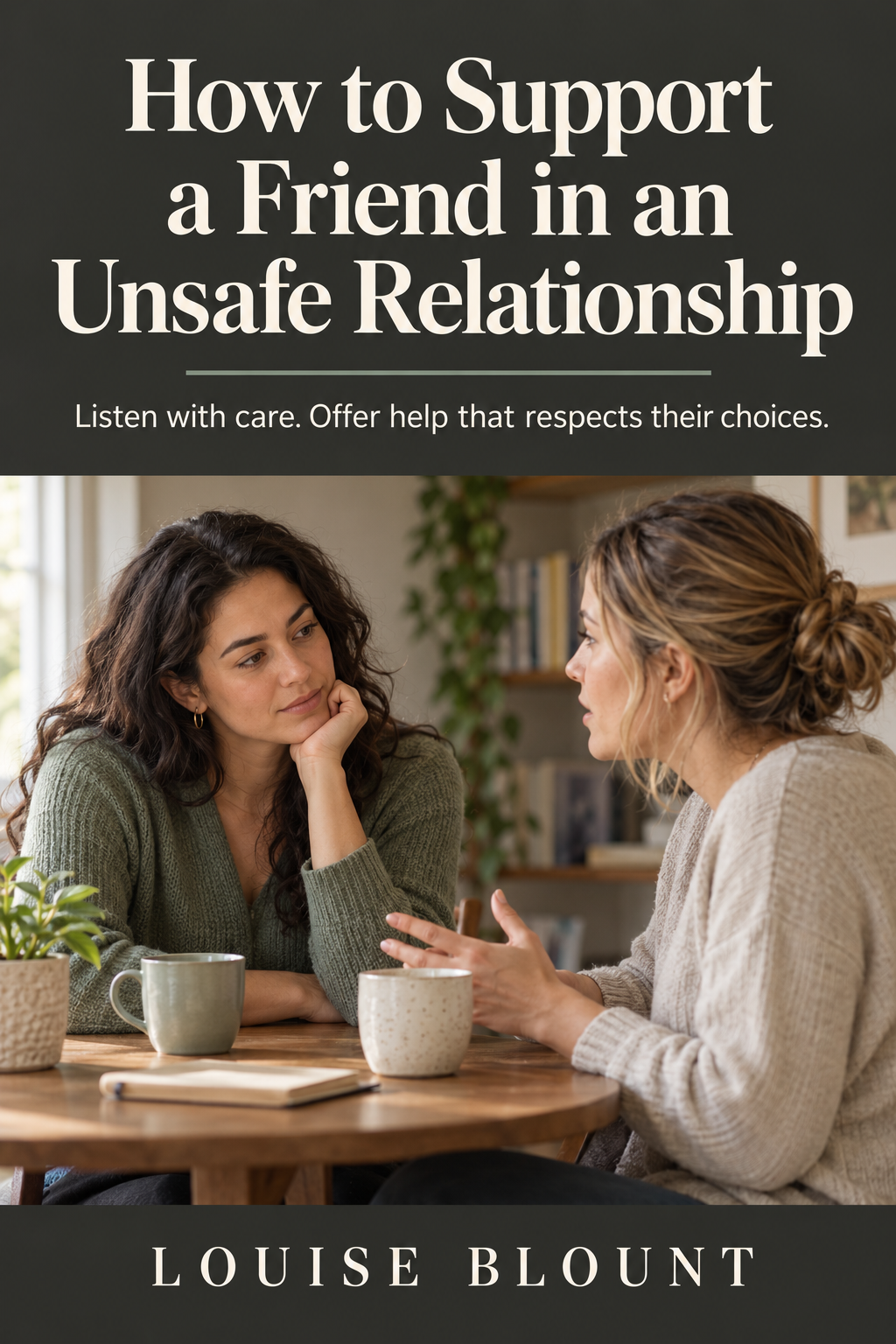
You want to help. But what should you say—and what should you do?
When a friend seems frightened, isolated, or controlled in their relationship, knowing how to respond can feel overwhelming. You may worry about saying the wrong thing, pushing them away, or offering help that unintentionally creates more risk.
In How to Support a Friend in an Unsafe Relationship, Louise Blount offers a compassionate, research-informed guide to being a steady source of support. Learn how to listen, offer practical assistance, protect privacy, and respect your friend’s choices while recognizing the limits of your own role.
Inside, you will explore:
- How to express concern without demanding proof or forcing a disclosure.
- Ways to listen and validate without interrogating or blaming.
- Why leaving can be complicated—and how to offer options without pressure.
- Practical help with transport, appointments, everyday needs, and specialist support.
- Digital privacy considerations before sending messages, sharing photographs, or changing account access.
- Situations where urgent medical, emergency, or crisis help matters.
- How to remain supportive through changed plans and uncertainty.
- Boundaries that protect your own wellbeing and make your support sustainable.
Clearly labelled fictional case studies, realistic examples, sample conversation openings, and manageable to-do lists bring the guidance into everyday situations. The book also examines recent research on informal support, disclosure responses, and the wellbeing of people helping survivors, with clear explanations of what the evidence can—and cannot—tell us.
This professionally designed, 33-page PDF includes 6,000 words of main text, 12 chapters, a support directory, and 17 references, including research published in 2025 and 2026.
You do not need to solve someone’s entire situation to offer meaningful help. Begin with care, ask permission, make a realistic offer, and keep your friend’s voice at the centre.
Author: Louise Blount
Format: PDF ebook
Edition: October 2026
An educational guide, not an individual safety assessment or a substitute for specialist, medical, emergency, or legal assistance.


Reviews
There are no reviews yet.